Break-Even ROAS for Indian D2C Brands: The Formula With GST, COD and RTO
Most break-even ROAS calculators are built for the US and ignore GST, cash on delivery and return-to-origin. Here is the India version of the formula, a worked example, and how to find the ROAS you actually need.
"Is a 3x ROAS good?" is the most common question I get from D2C founders. The honest answer: it depends entirely on your margins. A 3x ROAS can be very profitable for a cosmetics brand and a loss for a jewellery brand.
The number you need is your break-even ROAS, the return at which ads pay for themselves and nothing more. Most online calculators are built for the US and skip the costs that matter most in India: GST, cash on delivery and return-to-origin (RTO). Here's the India version.
The formula
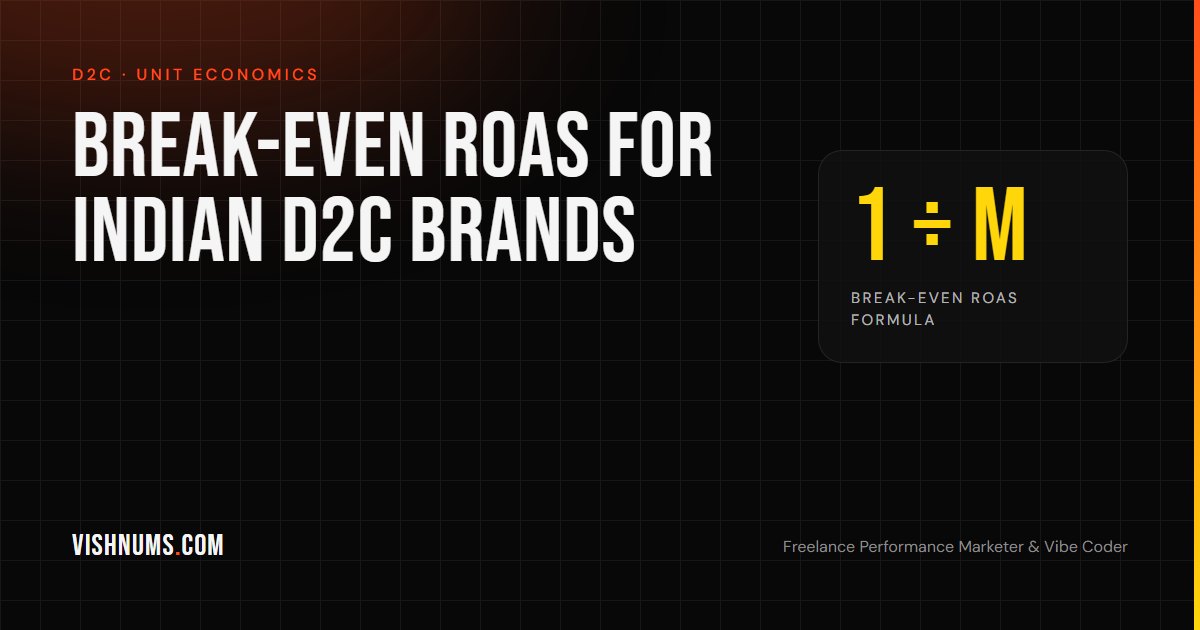
Break-even ROAS = 1 ÷ contribution margin
Contribution margin is the share of each rupee of revenue left after all the variable costs of fulfilling an order, before ad spend. If you keep ₹40 of every ₹100 of revenue after product, shipping, fees and returns, your margin is 40% and your break-even ROAS is 1 ÷ 0.40 = 2.5x.
Below 2.5x you lose money on every ad-driven sale. Above it, you make money. Simple, as long as you count costs properly.
The Indian costs most calculators miss
1. GST
Meta and Shopify often report revenue including GST, but GST isn't your money. You collect it and pay it to the government. Calculate ROAS on revenue excluding GST, or your break-even will look lower than it really is. After the September 2025 GST rationalisation, most goods fall in the 5% or 18% slabs, while gold jewellery is taxed at 3%. The same applies on the cost side: if you can't claim the GST on your Meta ad invoices, your real ad cost is 18% higher than Ads Manager shows.
2. Cash on delivery and payment fees
Online payments through gateways typically cost around 2% per transaction. COD orders usually carry a separate courier COD fee. Use your real blended rate.
3. RTO (return to origin)
This is the cost that quietly kills Indian D2C margins. When a COD order is refused at the door, you pay shipping both ways, the packaging is wasted, and you've also paid for the ad that brought the order. RTO rates on COD are often far higher than on prepaid orders. Count the cost of RTO across all orders, not just the ones that arrive.
4. Discounts and free shipping
Festive discounts, coupon codes and free shipping thresholds all reduce your margin. Calculate break-even ROAS at the price customers actually pay, not your list price.
A worked example
Here's an illustrative D2C product that sells for ₹1,000 plus 18% GST. Your own numbers will differ. The point is to see how the costs stack up.
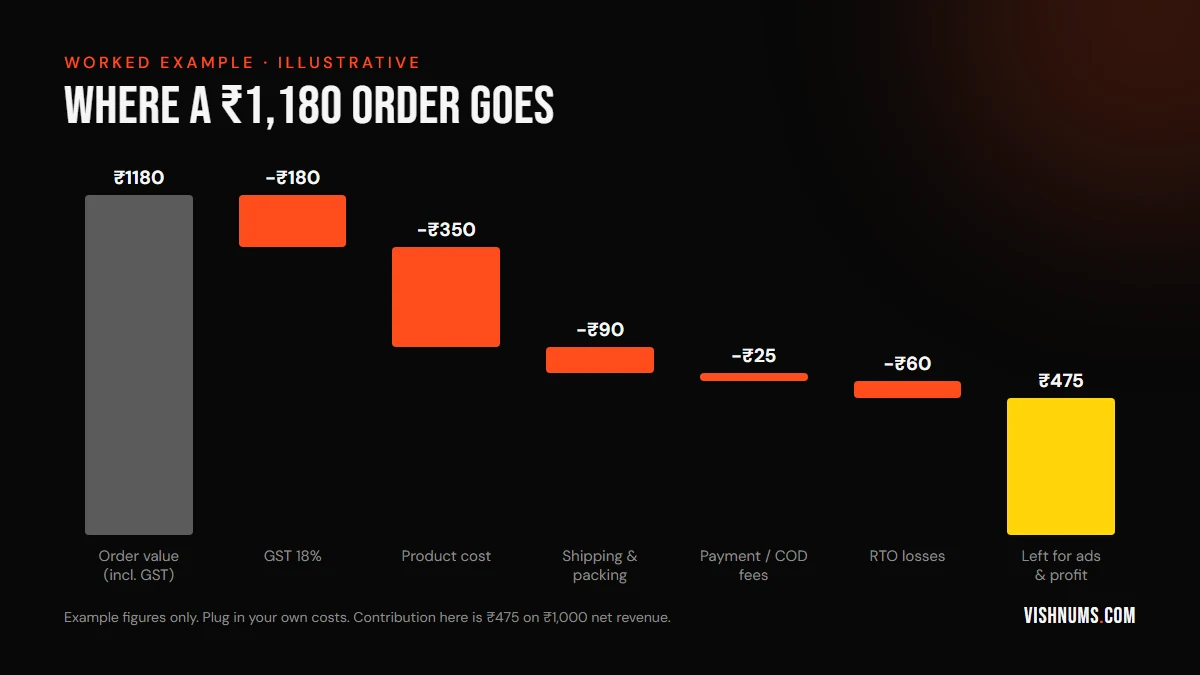
- 01Order value: ₹1,180, of which ₹180 is GST. Net revenue: ₹1,000.
- 02Product cost: ₹350.
- 03Shipping and packing: ₹90.
- 04Payment gateway and COD fees: ₹25.
- 05RTO losses, averaged across all orders: ₹60.
- 06Left over: ₹475, a 47.5% contribution margin.
Break-even ROAS = 1 ÷ 0.475 = 2.11x, measured on revenue excluding GST. If you measure on revenue including GST, your break-even becomes 2.11 × 1.18 = 2.48x. Make sure your dashboard and your target use the same definition.
Break-even ROAS by margin
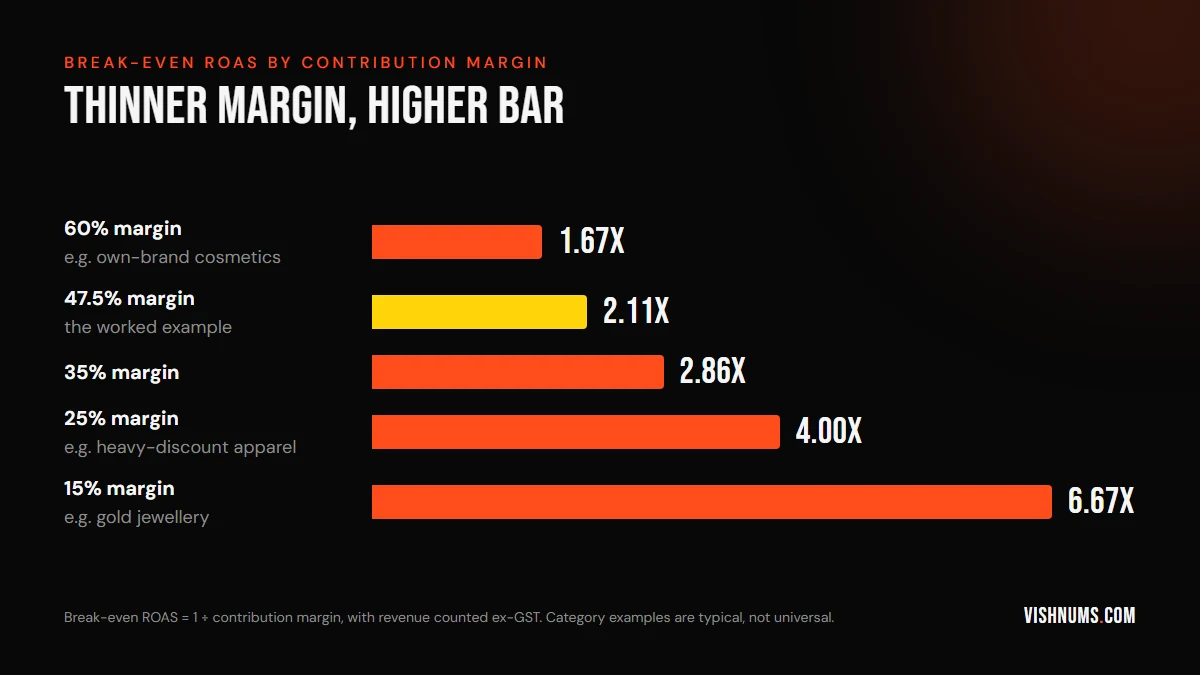
This is why category matters so much:
- High-margin categories like own-brand cosmetics or supplements can be profitable at 2x.
- Thin-margin categories like gold jewellery, where the metal itself is a large share of the price, may need 6x or more.
For the Kerala jewellery brand I work with, every month of 2026 closed above 5x, and the best month hit 8.32x. That's well above the 3–4x many people quote as "good", and in jewellery you need it. I wrote about that in detail in what is a good ROAS for jewellery brands.
From break-even to target ROAS
Break-even means zero profit. Your target should be higher, depending on what you want:
- To make a profit on the first order, aim for a ROAS above break-even, with a margin of safety for fixed costs like salaries, rent and software.
- If customers buy again, you can afford to break even, or even lose a little, on the first order, because repeat orders don't need new ad spend. This only works if you've actually measured repeat purchase rates.
- For brand-building campaigns (prospecting, video), judge them on the blended ROAS of the whole account, not each campaign alone. Prospecting feeds retargeting.
Ways to lower your break-even ROAS
You can hit your target by improving ads, or by needing less from them:
- Push prepaid orders. A small prepaid discount often costs less than COD fees and RTO losses.
- Verify COD orders with a WhatsApp or call confirmation before shipping.
- Raise average order value with bundles and free-shipping thresholds.
- Renegotiate shipping once your volumes grow.
- Cut RTO-prone pin codes from COD if your data shows a pattern.
RTO is usually the easiest cost to cut. Here's the full playbook: how to reduce RTO on COD orders from Meta ads.
Frequently asked questions
What is a good ROAS for D2C brands in India?
There's no single number. A good ROAS is one comfortably above your break-even ROAS, which is 1 divided by your contribution margin. For a 50% margin that's 2x; for a 20% margin it's 5x.
Should ROAS include GST?
Calculate it on revenue excluding GST, because GST isn't your income. If your reports include GST, adjust your break-even target to match.
How do I include RTO in break-even ROAS?
Add up the full cost of returned orders (forward and return shipping, packaging, fees) over a month, divide by all orders shipped, and include that average as a cost per order when you calculate contribution margin.
Want your ads judged against your real break-even, not a generic benchmark? Get a quote.
Ads, a website that converts, or both: get a custom quote.