Click-to-WhatsApp Ads vs Lead Form Ads in India: Which Gets More Sales?
Lead forms are cheap and fast. WhatsApp chats are warmer and harder to fake. Here is when each one wins in India, what the vendor claims leave out, and how to test them on your own account.
If you run Meta Ads for leads in India, you'll eventually choose between two buttons: an instant lead form, or "Send WhatsApp message". Search the question and you'll find confident answers, almost all written by companies that sell WhatsApp tools or lead-form software.
Here's a more honest comparison, based on running both for businesses in Kerala, including a Munnar resort that generated 63,379 leads at a ₹45 blended cost per lead across 2026.
How each one works
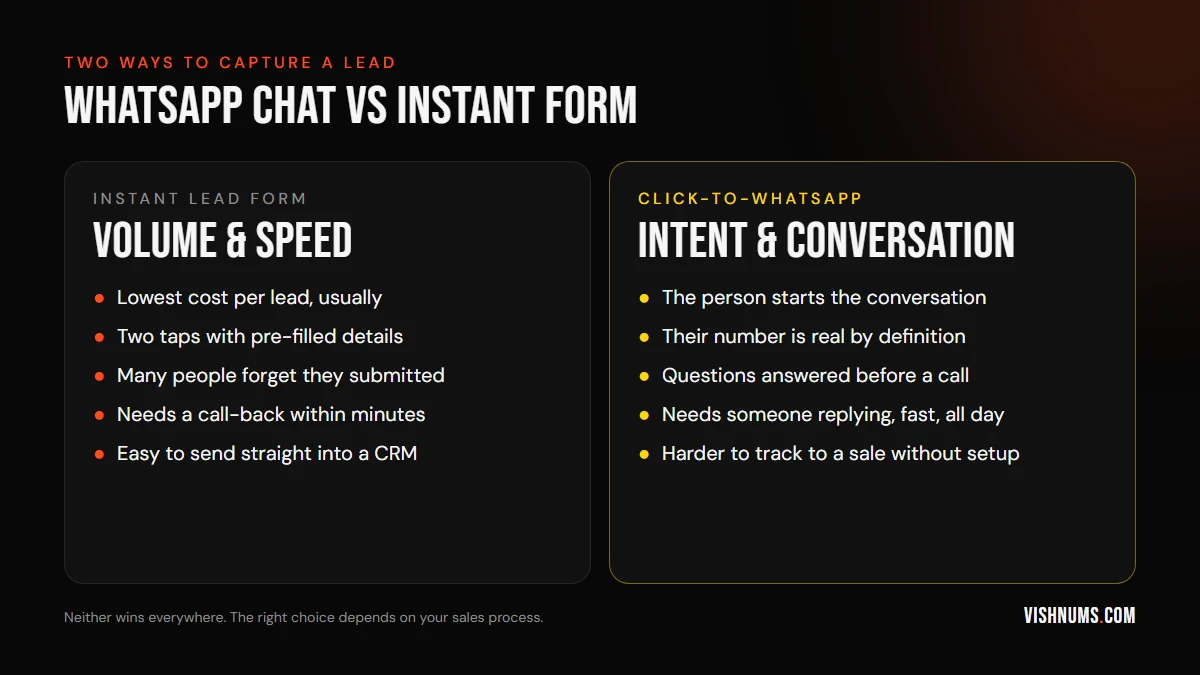
Instant lead forms
Someone taps your ad and a form opens inside Facebook or Instagram, with their name, phone and email already filled in. Two taps and they're a lead. You get their details and must contact them.
Click-to-WhatsApp ads
Someone taps your ad and WhatsApp opens with a chat to your business, often with a pre-written first message. They hit send, and the conversation begins. You reply on WhatsApp.
Where lead forms win
- Volume and cost. Forms are usually the cheapest way to collect contact details. That's useful when you have a team ready to call.
- CRM integration. Form leads flow straight into CRMs like TeleCRM, HubSpot or a Google Sheet, with campaign and ad details attached. That makes it much easier to see which campaigns produce bookings.
- Simple offers. For a callback request, a brochure, an event or a free consultation, a form is quick and clean.
The catch
Forms are so easy that some people submit them without much thought. When your team calls the next day, the person has forgotten, doesn't pick up an unknown number, or says they were "just checking". That's why speed matters so much. My guide to following up enquiries covers the cadence that works.
Where click-to-WhatsApp wins
- Higher intent. The person has to open WhatsApp and send a message. That small effort filters out some casual taps.
- Real numbers. You're chatting with the actual WhatsApp number. No typos, no fake entries.
- People prefer it. Many Indians would rather type a question on WhatsApp than take a call from an unknown number.
- Questions first. For hotels, clinics, restaurants, coaching and custom products, people want to ask about price, dates or availability before committing. Chat suits that.
The catch
WhatsApp needs someone replying quickly, all day, including evenings and weekends. A chat left for three hours is often a lost customer. Tracking is also harder: unless you tag chats with their ad source and record outcomes, you won't know which campaigns produced sales. Messaging costs also apply for some conversations under Meta's WhatsApp Business pricing, though conversations that start from a click-to-WhatsApp ad come with a free window. Check Meta's current pricing for your country.
What the vendor claims leave out
You'll see claims like "WhatsApp leads cost 30% less" or "convert three times better". Treat them carefully:
- They're mostly published by companies that sell WhatsApp software.
- They rarely compare the two on cost per sale, which is the only number that matters.
- They don't tell you anything about your audience, your offer or your team.
The only comparison that counts is the one from your own account.
How to choose
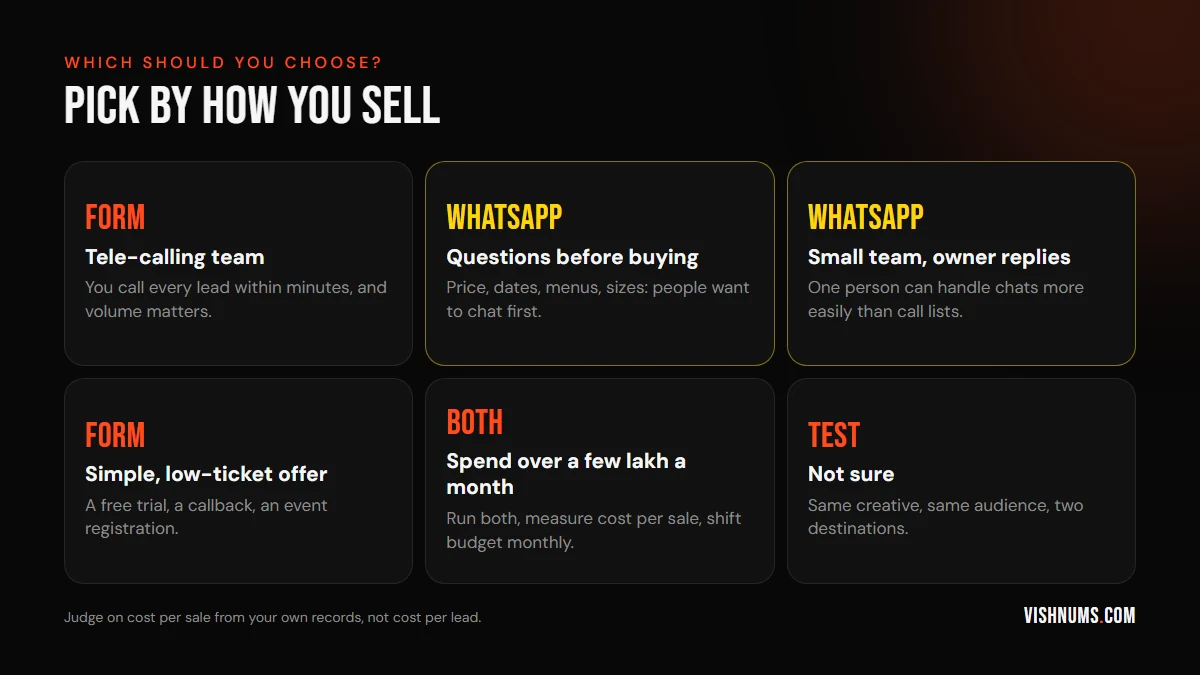
- Lead forms if you have a tele-calling team that calls every lead within minutes, and volume matters.
- WhatsApp if customers usually ask questions before buying, or a small team (or the owner) handles enquiries.
- Both once you spend enough to run them side by side, and shift budget monthly toward whichever produces cheaper sales.
How to test them fairly
- 01Same creative and audience. Run two ad sets, identical except for the destination: form or WhatsApp.
- 02Same budget and time. Run them at the same time, for long enough to get real sales from each.
- 03Track every lead to an outcome. Tag WhatsApp chats with their source (most WhatsApp Business tools and CRMs can do this) and mark every lead Won or Lost.
- 04Compare cost per sale, not cost per lead. Forms will almost always win on cost per lead. The question is whether they win on cost per booking or purchase.
To compare them fairly, you need to know which WhatsApp chats became sales. These are three ways to track WhatsApp leads from Facebook ads.
Improve whichever you choose
For lead forms
- Add one qualifying question (dates, budget, city) to filter out casual submissions.
- Use the "higher intent" form type, which adds a review step before submitting.
- Call within minutes, and send a WhatsApp message if they don't answer.
For WhatsApp
- Set up quick replies with prices, photos and FAQs.
- Use an automated greeting that sets expectations ("We reply within 15 minutes, 9am to 9pm").
- Record every chat's outcome so you can measure cost per sale.
Frequently asked questions
Are click-to-WhatsApp ads cheaper than lead forms?
Not usually on cost per lead. Forms tend to be cheaper per lead. WhatsApp leads can be cheaper per sale if they convert better, but that depends on your business and needs testing.
Can I connect WhatsApp leads to a CRM?
Yes. Many CRMs and WhatsApp Business API providers capture the chat, the phone number and the ad it came from. Without that, it's very hard to measure which campaigns produce sales.
Which is better for Ayurveda centres and houseboats?
Both tend to suit WhatsApp, because guests ask a lot of questions first. See my guides for Ayurveda centres and Alleppey houseboats.
Which is better for hotels and resorts?
Both work. Guests often have questions about rooms, dates and prices, which suits WhatsApp. Forms work well when a reservations team calls back quickly. Many resorts run both and compare cost per booking.
If you're not sure which suits your business, I can set up a proper test and show you the cost per sale for each. Request a quote.
Ads, a website that converts, or both: get a custom quote.