Google Ads for Resorts in Kerala: Keywords, Budgets and Real Conversion Rates
Google Ads leads converted into bookings at 5.6% for a Munnar resort, more than three times the Meta rate. Here is the keyword structure, budget logic and campaign setup behind a 6.4x Google ROAS month.
Most Kerala resorts run Google Ads the same way: one campaign, a handful of broad keywords like "resorts in Munnar", and a budget that runs out by lunchtime. Then they decide Google "doesn't work" and move everything to Instagram.
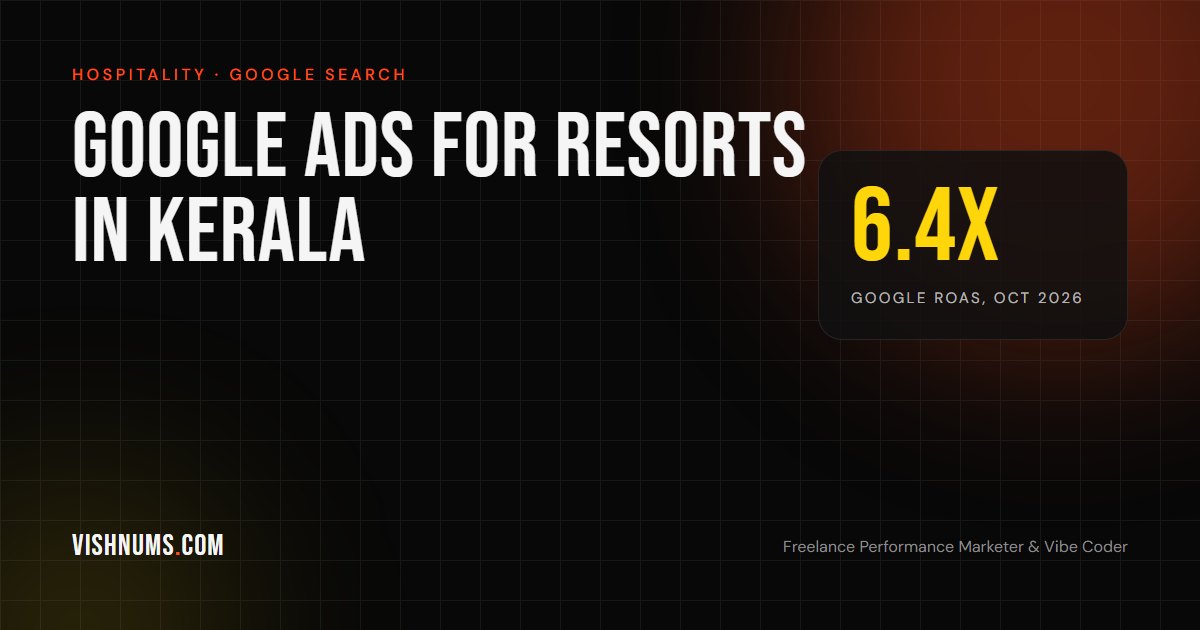
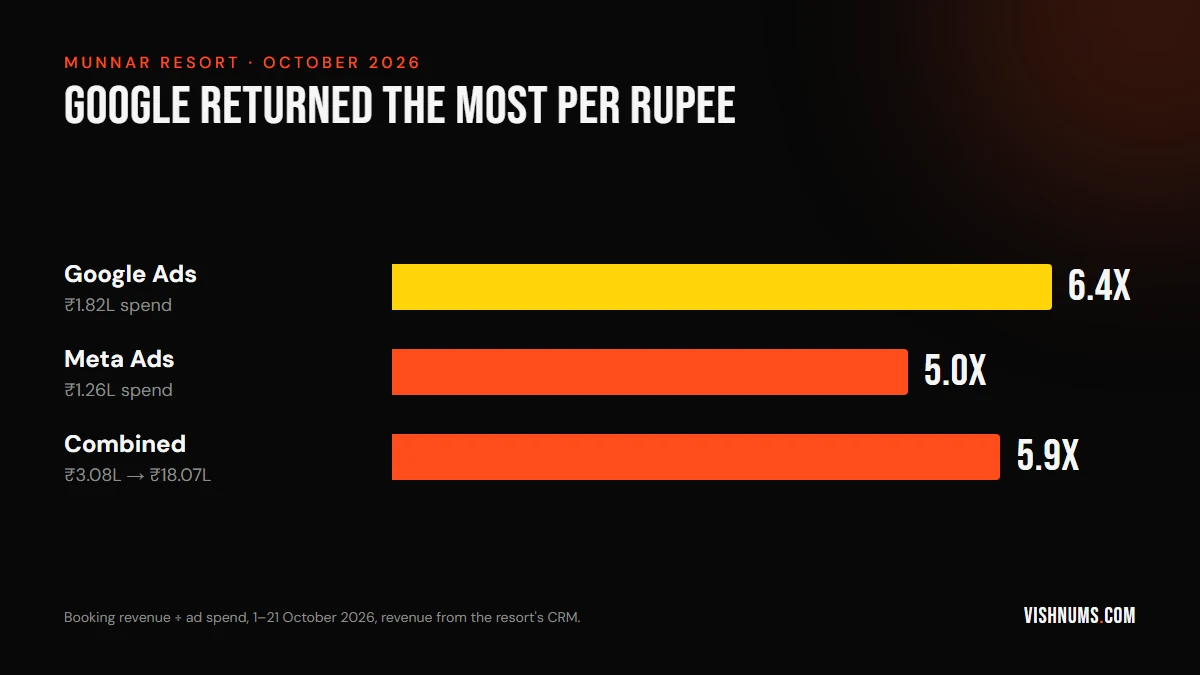
For the Munnar resort I run ads for, Google is the channel that turns enquiries into bookings most reliably. Across 2026, 5.6% of Google Ads leads became bookings, against 1.7% for Meta. In October, Google returned 6.4x on its spend, the best of any channel. Here is how the account is built.
Why Google behaves differently from Meta for resorts
On Instagram you interrupt someone who wasn't planning a trip. On Google, the traveller has already decided to go somewhere and is now choosing where to stay. That difference shows up in every number:
- Meta brings volume. It produced most of the resort's 63,379 leads this year at a ₹45 blended cost per lead.
- Google brings intent. Fewer leads, but each one is three times more likely to book.
You need both, but they do different jobs. Meta fills the funnel; Google catches people at the bottom of it. If you only run one, you're either paying for curiosity or missing the people who are ready to book.
Build the account around intent, not destinations
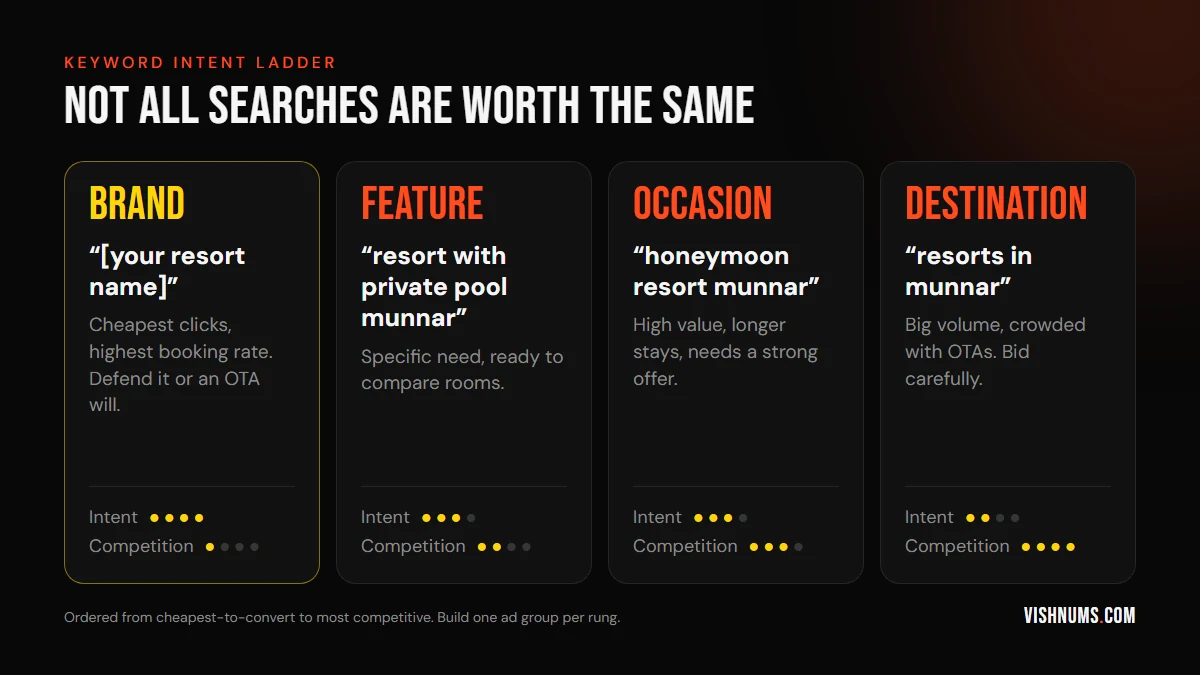
The biggest mistake is bidding on "resorts in Munnar" and stopping there. That keyword is dominated by MakeMyTrip, Booking.com and Agoda, who can outbid a single property all day. Instead, split your keywords into four rungs, each in its own ad group with its own ad copy.
1. Brand keywords
People searching your resort's name are the cheapest bookings you'll ever win. If you don't bid on your name, OTAs often will, and they'll charge you 15–25% commission for a guest who was already looking for you. Keep a small, always-on brand campaign.
2. Feature keywords
These are searches for something specific: a private pool, a plantation view, a tree house, a pet-friendly stay. For the Munnar resort, terms like "resort with private pool Munnar" became a core part of the account. Over the year its impression share on key terms grew from 5% to 12%, meaning the ads showed for more than twice as many of the searches that mattered.
The rule: only bid on features you actually have, and put that feature in the headline. Someone searching "pool villa Munnar" wants to see "Private Pool Villas in Munnar", not "Best Resort in Kerala".
3. Occasion keywords
Honeymoon, anniversary, family trip, corporate offsite, wedding. These searchers book longer stays and spend more, so they deserve their own ad groups with a dedicated offer (a candle-light dinner, a free night on four, a group rate) and a landing page that talks about that occasion.
4. Destination keywords
"Resorts in Munnar", "Munnar hotels", "best resorts in Kerala". These bring the most volume and the most competition. Run them, but with a firm cost-per-click ceiling, and judge them on bookings, not clicks. If they cost you more per booking than the other rungs, cap their budget.
How much budget does a Kerala resort need for Google Ads?
There's no universal number, but there's a sound way to set it:
- 01Start with your brand and feature campaigns. They're cheaper and convert best. Fund them so they don't run out of budget before evening, when many people plan trips.
- 02Add occasion campaigns around the dates that matter: long weekends, school holidays, the honeymoon season after wedding months.
- 03Give destination keywords what's left, and only if your cost per booking stays below what an OTA commission would cost you.
For context, in October the resort spent ₹1.82L on Google and ₹1.26L on Meta. Google got the bigger share that month because it was producing bookings more efficiently, not because of a fixed rule. Budget should follow bookings, and that only works if you can see bookings per channel.
Campaign settings that waste money (and what to change)
- Location targeting: set it to "People in or regularly in your targeted locations", not "interested in". Then target the cities your guests actually come from (for Munnar: Kochi, Bengaluru, Chennai, Coimbatore and the Gulf), rather than "India".
- Search partners and Display: turn off the Display Network inside search campaigns. It sends cheap, low-intent clicks that make your cost per click look good and your bookings look bad.
- Negative keywords: block jobs, free, cheap, wedding venue enquiries you can't host, and every competitor name you don't want. I've put together a ready-made negative keyword list for hotels and resorts.
- Call assets: add your reservations number. A lot of Kerala bookings still happen on the phone, and a call from a search ad is one of the highest-intent leads you'll get.
- Ad schedule: check when bookings (not clicks) happen and shift bids toward those hours.
Track bookings, not just clicks
Google will happily report clicks, form submissions and "conversions" that are really page views. None of that tells you whether you made money. For this account, every lead goes into the resort's CRM, where the team marks it Fresh, Interested, Won or Lost. Revenue is counted only when a booking is recorded, and cancellations are excluded.
That is how we know Google converts at 5.6% and returned 6.4x in October. Without it, the resort would have judged Google on cost per click and probably cut the channel that books best.
If your booking engine is a separate website, check whether a completed booking even shows up in GA4. Often it doesn't. I explain how to fix that in GA4 tracking for hotel booking engines.
Your Google Business Profile drives bookings too, and you can track it separately with a tagged website link. See my Google Business Profile guide for Kerala resorts.
A simple checklist before you launch
- Brand, feature, occasion and destination keywords in separate ad groups
- Headlines that repeat the searcher's words, plus your strongest real feature
- Location set to "in or regularly in", aimed at your guests' home cities
- Display Network off, negative keyword list attached
- Call asset with a number someone actually answers
- Every lead landing in a CRM or sheet with a Won or Lost outcome
Frequently asked questions
Is Google Ads or Meta Ads better for resorts?
They do different jobs. In this resort's data, Meta produced most of the leads and Google converted them three times better. Most resorts should run both, then shift budget monthly toward whichever produces cheaper bookings.
Should a resort bid on its own name?
Yes. Brand clicks are cheap, and if you don't show up, an OTA ad often appears above your own listing and takes a commission on a guest who was searching for you.
How long before Google Ads produces bookings?
Brand and feature campaigns can produce enquiries in the first week. Give the account four to six weeks of booking data before judging which keywords to scale.
Running a smaller property? See how to market a homestay in Kerala or digital marketing for Alleppey houseboats.
For the full picture of how this resort's funnel works across Meta, Google and the CRM, read the Munnar resort case study. If you run a resort and want this set up for you, request a quote.
Ads, a website that converts, or both: get a custom quote.