Performance Marketing vs Digital Marketing: What's the Difference and Which Do You Need?
Digital marketing is the umbrella; performance marketing is the part you pay for only when it produces results. Here is the real difference, with numbers from live Indian ad accounts, and how to decide which your business needs first.
Ask ten agencies the difference between performance marketing and digital marketing and you'll get ten answers, most of them designed to sell you something. Here is the plain version, from someone who has run Meta Ads and Google Ads since 2016.
The short answer
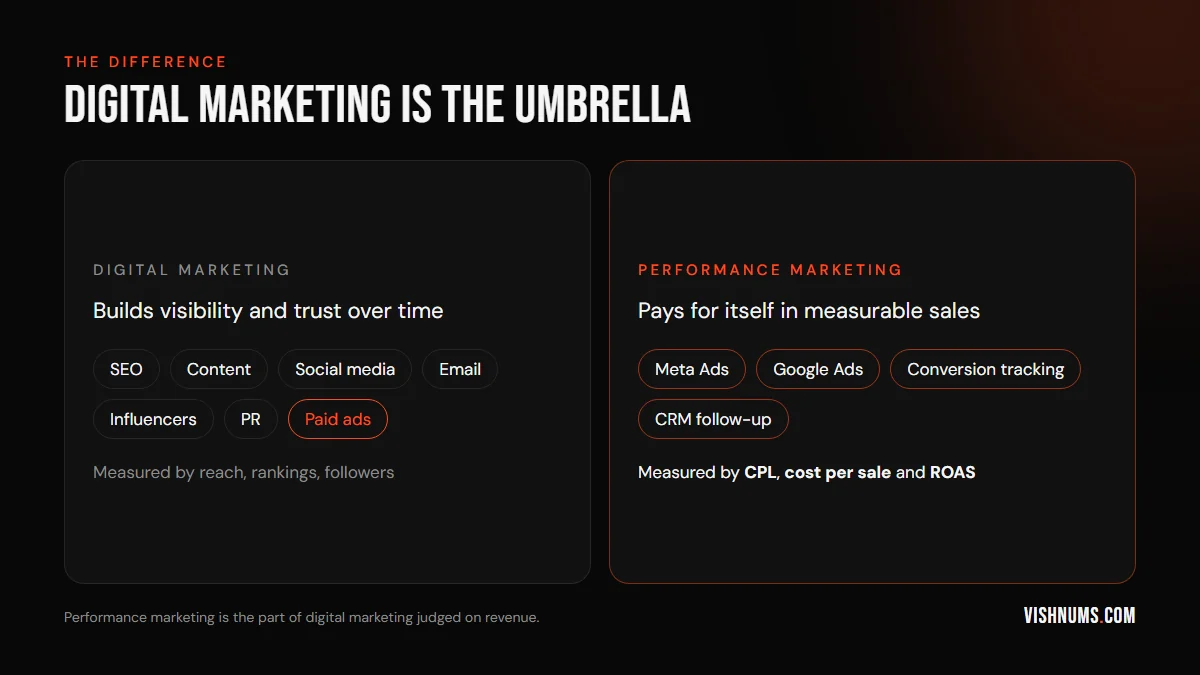
Digital marketing is everything a business does to win customers online: SEO, social media, content, email, influencers, and paid ads.
Performance marketing is the part of digital marketing where every rupee is tied to a measurable result: a lead, a booking, a purchase. You judge it by what it returns, not by how many people saw it.
So performance marketing is not the opposite of digital marketing. It sits inside it. The real question is how much of your effort should be performance-driven, and when.
The difference in one table
- Goal: digital marketing builds visibility, trust and brand over time. Performance marketing produces sales and leads now.
- How you pay: digital marketing is often a fixed retainer or a content budget. Performance marketing is ad spend you can switch up or down daily.
- How you measure: digital marketing uses reach, followers, rankings and engagement. Performance marketing uses cost per lead, cost per sale and ROAS (return on ad spend).
- Time to results: SEO and content take months. A performance campaign can produce leads within days.
- Main channels: digital marketing covers everything. Performance marketing in India is mostly Meta Ads (Facebook and Instagram) and Google Ads.
What "performance" actually means
A performance campaign is only as good as its measurement. If you can't connect an ad to a sale, you're doing digital marketing with a performance label.
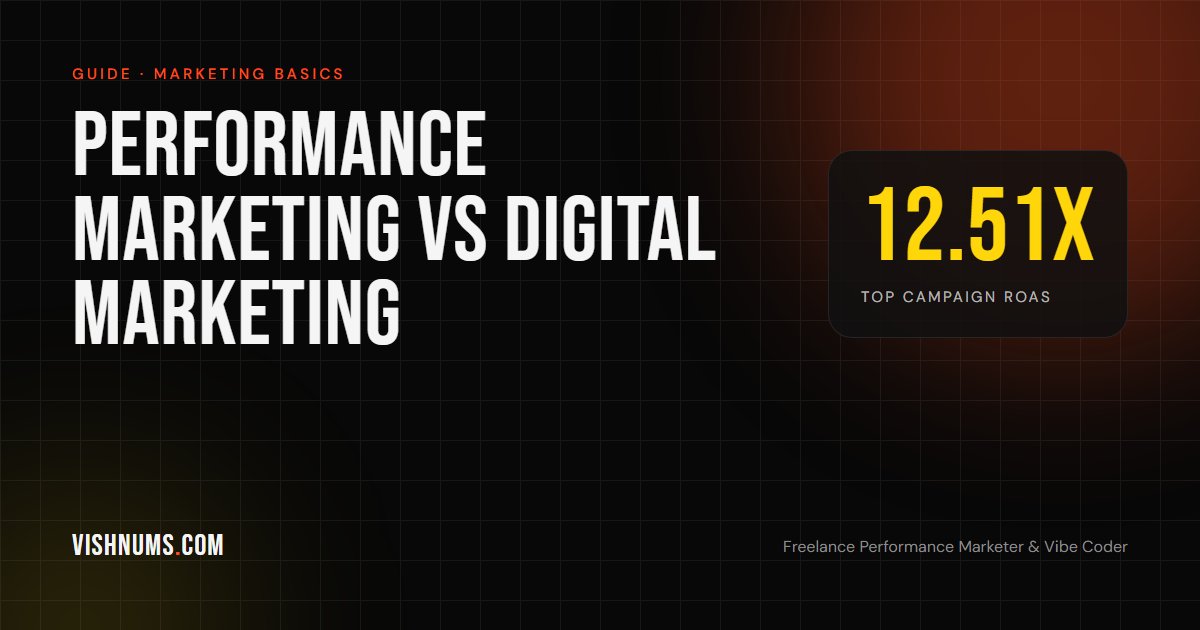
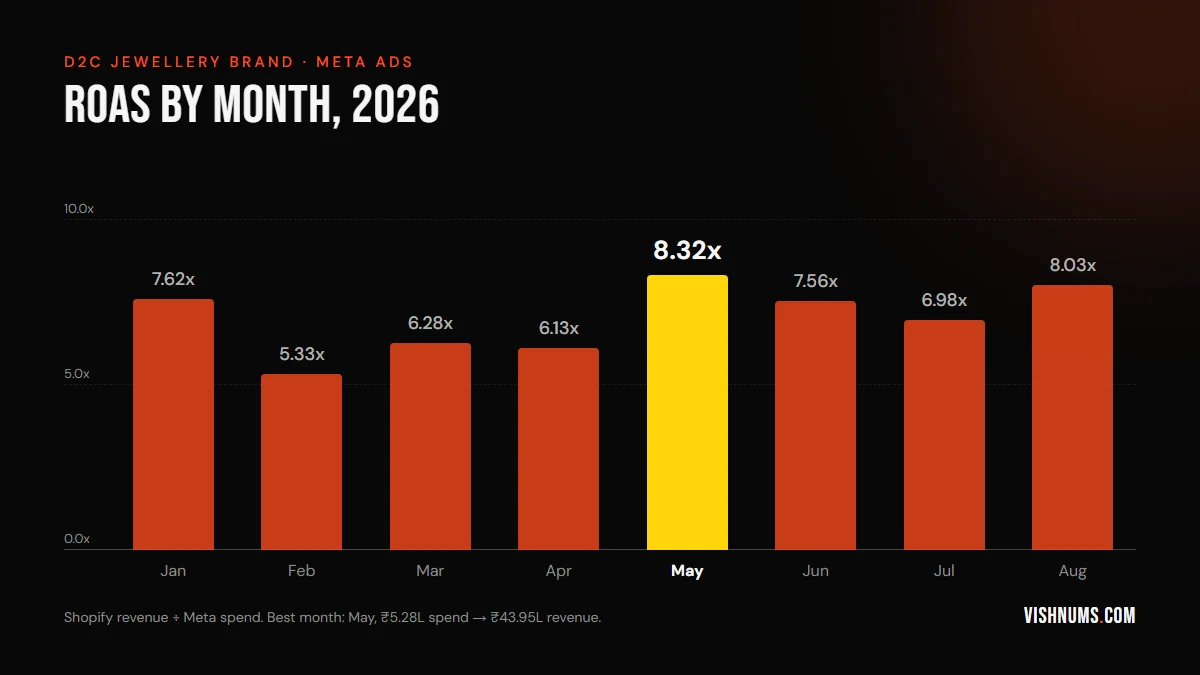
Here is what real measurement looks like. For a D2C jewellery brand, I tied every Meta campaign to Shopify revenue. The top campaign, dynamic catalogue retargeting, returned 12.51x: every ₹1 spent brought back ₹12.51 in store revenue. In its best month the whole account returned 8.32x, turning ₹5.28L of spend into ₹43.95L of revenue. See the full case study.
For a resort in Munnar, revenue came from the CRM, where the team records every booking. In October 2026, ₹3.08L of Meta and Google spend produced ₹18.07L in bookings, a 5.9x return. See how.
Neither number came from Ads Manager. Both came from the business's own records. That is the difference between performance marketing and running ads.
When digital marketing (the broad kind) wins
Performance marketing is not always the right first move. Broad digital marketing matters more when:
- Nobody knows you yet. Ads convert better when people have heard of you. Content, social and PR build that familiarity.
- You sell something people research for months, like property or education. SEO and content catch them early in the search.
- Your margins can't support paid acquisition yet. If one customer is worth ₹500, a ₹400 cost per sale leaves nothing.
- You want traffic that keeps coming without paying per click. A good article can bring visitors for years.
When performance marketing wins
Lean on performance marketing when:
- You need sales this month, not next year.
- You know what a customer is worth and can afford to pay a part of that to win one.
- You can track the sale: a CRM, Shopify, a booking engine, or even a disciplined spreadsheet with a Won or Lost status for every lead.
- You want to scale predictably. If ₹1 returns ₹5, you can spend more with confidence.
The answer for most Indian businesses: both, in the right order
- 01Fix tracking first. Pixel, Conversions API, GA4, and a CRM where every lead gets an outcome. Without this, nothing else can be judged. My Meta Ads audit checklist covers the tracking checks.
- 02Run performance campaigns on Meta and Google to produce revenue now. Start small, find what converts, then scale it.
- 03Build the website to convert the traffic you're paying for. Most campaigns leak at the landing page, not in the ad.
- 04Layer in SEO and content so a share of your customers arrive without a cost per click.
The businesses that grow fastest treat performance marketing as the engine and broad digital marketing as the fuel that makes it cheaper over time.
Questions to ask anyone selling you either
- How will you measure success, and from which records: yours or the ad platform's?
- What will my cost per lead and cost per sale be, and how will you report it?
- Who owns the ad accounts and the data if we stop working together?
- What happens on the landing page after someone clicks?
If the answers are about reach and impressions, you're buying digital marketing. If they're about revenue in your own records, you're buying performance marketing.
For a longer list, see 12 questions to ask before hiring a Meta Ads expert.
Need a hand?
I'm a freelance performance marketer and vibe coder in Kerala: I run Meta Ads and Google Ads against revenue you can verify, and I build the websites and dashboards that make the measurement possible. See what I offer, or get a quote.
Ads, a website that converts, or both: get a custom quote.