Malayalam, Tamil or English? Running State-Wise Meta Ads in South India
Should your Meta ads speak Malayalam, Tamil, Kannada or English? The evidence is mixed. Here is how to structure state-wise campaigns and test language fairly, from a brand that runs them in three states.
If you sell across South India, you'll face this question sooner or later: should your ads be in Malayalam, Tamil, Kannada or English?
Ask around and you'll hear confident answers both ways. Some agencies say regional language ads always win. Others say English performs better because it signals a premium brand. The evidence, frankly, is mixed, and that's the most useful thing to know. Here's how to think about it, and how a Kerala jewellery brand I manage structures its campaigns across three states.
What the evidence says (and doesn't)
Studies and industry reports going back years have found that vernacular ads often get more clicks than English ones among mass-market audiences. But there are counterexamples too, including published campaign stories where English creative beat regional creative on engagement.
The pattern that seems to hold:
- Regional language tends to help with broad, mass-market audiences, older audiences, smaller towns, and emotional or cultural messages.
- English often holds up well with metro audiences, younger professionals, premium positioning, and categories like finance where people are used to reading in English.
- Mixed creative, where the voiceover is in the regional language and the on-screen text is in English (or the other way round), is extremely common in South India and often the safest starting point.
Treat any claim of "regional ads always perform X times better" with suspicion, especially when it comes from a company selling translation or ad tools. Your audience, product and creative matter more than any average.
Why state-wise campaigns beat one national campaign
Language is only part of the story. People in Kerala, Tamil Nadu and Karnataka buy different styles, celebrate different festivals, and respond to different faces and settings. One all-India ad speaks to nobody in particular.
For the jewellery brand, top-of-funnel Reels and video campaigns run state-wise for Kerala, Tamil Nadu and Karnataka, alongside all-India prospecting. The brand closed every month of 2026 above 5x ROAS, with 8.32x in its best month, and the state-wise prospecting is a big part of what keeps its retargeting pools full. See the full case study.
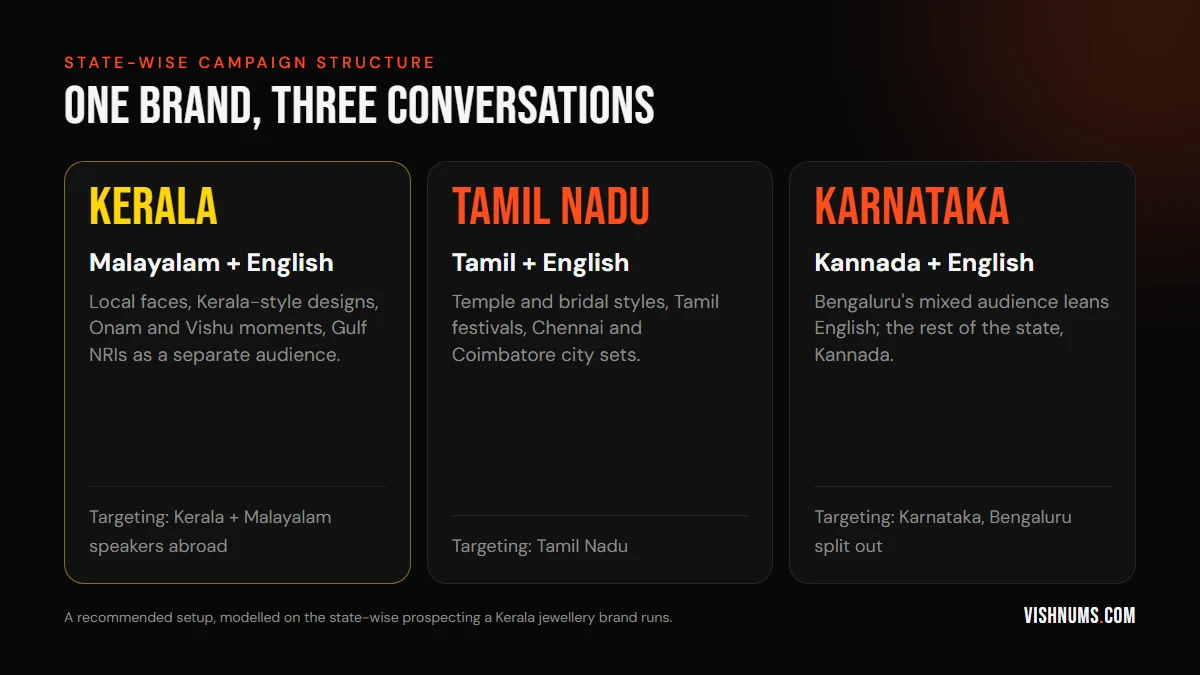
Kerala
Malayalam voiceover with clean English text works well. Kerala-style designs, local faces and moments like Onam, Vishu and weddings make the ad feel local. Treat Malayalis in the Gulf as their own audience: they buy for family at home and around festivals and holidays.
Tamil Nadu
Tamil creative with Tamil Nadu-specific styles: temple jewellery, bridal sets, and festivals like Pongal and Deepavali. Chennai and Coimbatore can each justify their own ad set if spend allows. Pilgrim season is another case where Tamil works in Kerala itself: hotels on the Sabarimala route need Tamil, Kannada and Telugu ads. See Sabarimala season marketing.
Karnataka
Bengaluru is unusual. It has a huge population from other states, so English and Hindi often perform there. The rest of Karnataka tends to respond better to Kannada. Splitting Bengaluru out of the state campaign lets you treat it differently.
How to test language properly
Most "Malayalam vs English" tests are worthless because they change several things at once.
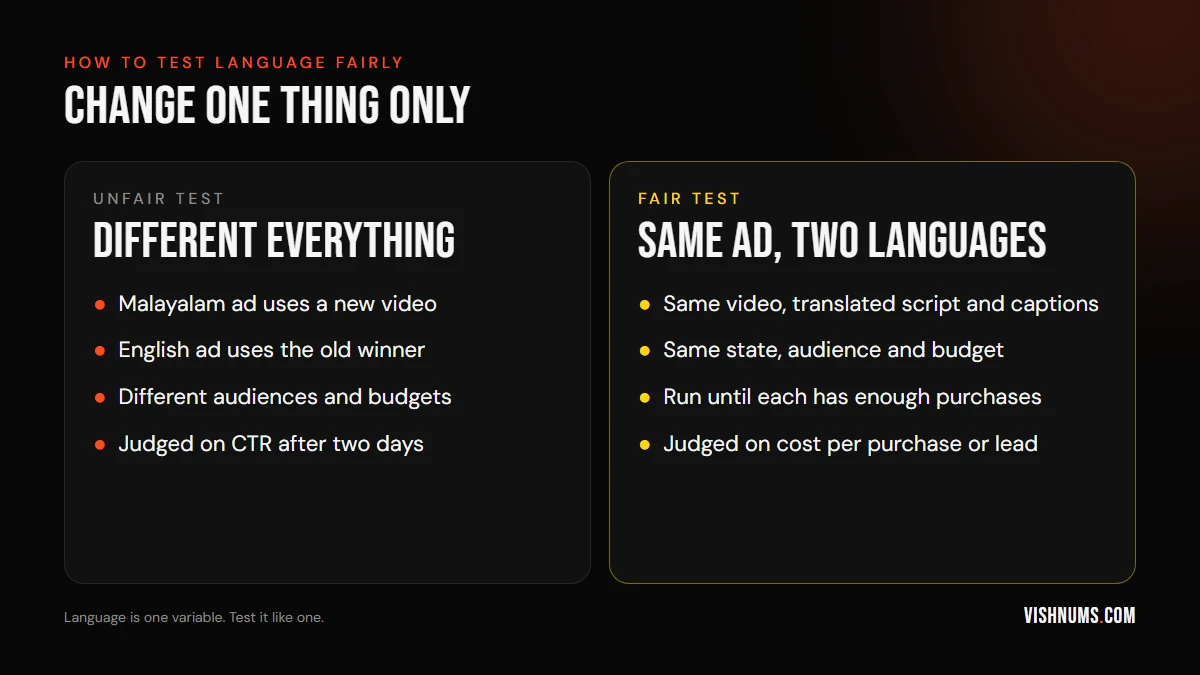
A fair test:
- 01Same creative. Take one video and produce two versions: one with a Malayalam script and captions, one with English.
- 02Same audience. Run both to the same state, age range and placements, ideally with Meta's A/B test tool so audiences don't overlap.
- 03Same budget. Give both an equal share.
- 04Enough data. Run it until each version has enough purchases or qualified leads to compare, not just a few hundred clicks.
- 05The right metric. Judge on cost per purchase or cost per qualified lead. A regional ad might get more cheap clicks from curious viewers who never buy. Or it might sell better. Only sales tell you.
Translation tips that matter
- Don't translate word for word. Adapt. Idioms, humour and festival references change between languages.
- Use native speakers for voiceovers and captions. A clumsy machine-translated script signals "not for you" faster than anything.
- Keep prices and numbers clear. Many people read numbers more easily in standard digits than in script.
- Check the landing page. If the ad is in Tamil and the website is in formal English, some people will drop off. At least make the key message and the call to action match.
When English alone is fine
If you sell a premium or technical product, target metro professionals, or have a very small budget that can't support multiple creative sets, a strong English ad with local faces and settings can work well. You can add regional versions later, once the English ad is proven.
Malayalam also works well for reaching Gulf Malayalis, for example in real estate ads aimed at NRI buyers.
Frequently asked questions
Do Malayalam ads perform better than English ads?
Sometimes. Regional language ads often do better with mass-market and older audiences, while English can hold up well in metros and premium categories. The only reliable answer for your business comes from a fair test judged on sales.
Should I target by language or by location?
Usually by location, with creative matched to that region. Meta's language targeting is useful for specific cases, such as reaching Malayalam speakers living in the Gulf.
How much budget do I need for state-wise campaigns?
Enough for each state's ad set to get regular conversions. If your budget is small, start with one strong all-India or single-state campaign, and split by state once you can fund each one properly.
Want campaigns that speak to each state properly? Request a quote.
Ads, a website that converts, or both: get a custom quote.