Meta Ads for Resorts in Kerala: How a Munnar Resort Hit 5.9x ROAS in a Month
A real 2026 breakdown from a Munnar resort: ₹3.08L of Meta and Google spend returned ₹18.07L in bookings in October, a 5.9x ROAS. Here is the funnel, budget split and follow-up system behind it.
Most resorts in Kerala run Meta Ads the same way: boost a few beautiful photos before the season, get a burst of likes, and then wonder why the bookings still come from OTAs that keep 15–25% commission.
This article breaks down a different approach, using real numbers from a nature resort in Munnar I worked with in 2026 (1 January – 21 October). Spend comes from Meta and Google, and revenue from the resort's own CRM, counted only where a booking can be traced back to an ad. No platform-estimated conversions.
The results first
In October 2026 the resort spent ₹3.08L on Meta and Google and booked ₹18.07L from those ads: a 5.9x ROAS in a single month. Google Search alone returned 6.4x.
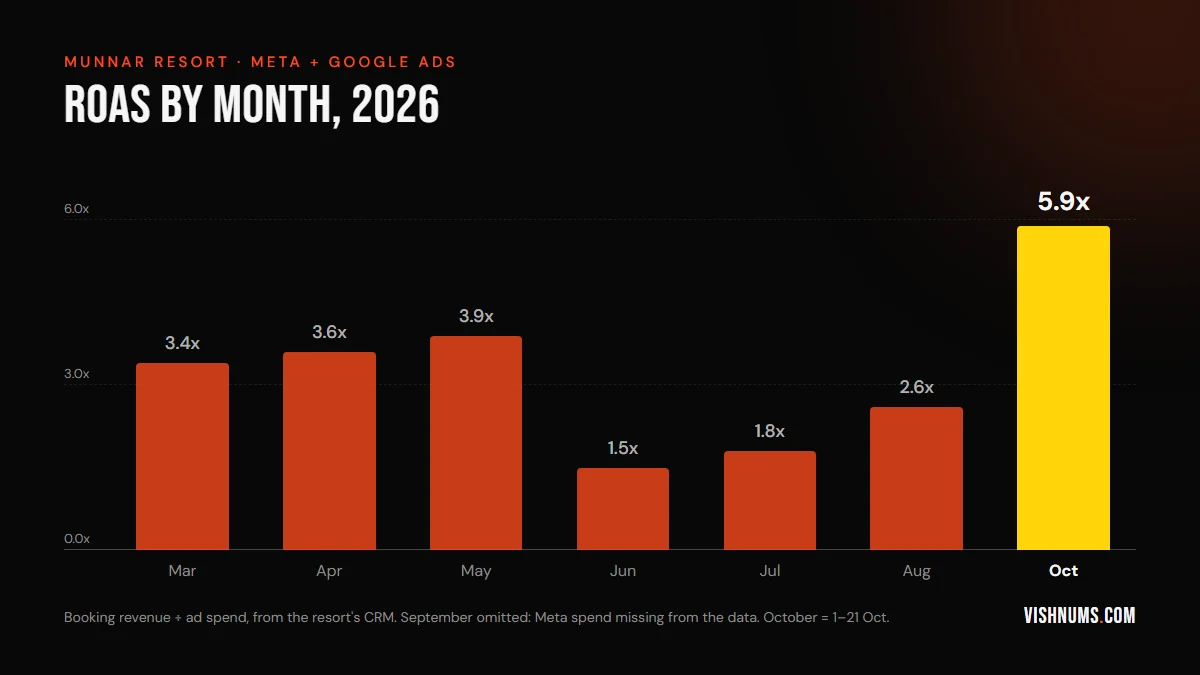
It took months to get there. Here is the funnel's ROAS month by month since it launched in March:
- March–May: 3.4x → 3.6x → 3.9x
- June–August: 1.5x → 1.8x → 2.6x (CPMs doubled and the summer season ended)
- October: 5.9x
Across the whole year so far the resort has:
- Spent ₹28.43L on ads (Meta ₹20.91L, Google ₹7.52L)
- Generated 63,379 leads at a ₹45 blended cost per lead
- Closed 453 bookings attributed to paid ads, worth ₹21,392 on average
- Earned ₹96.91L in booking revenue from those ads: a 3.4x ROAS
- Paid ₹6,277 in ad spend per confirmed booking
For context, published Indian benchmarks put average cost per lead anywhere from ₹150 to ₹2,000. ₹45 a lead, and about ₹6,300 of ad spend against a ₹21,000+ stay, is a very different business from paying an OTA 15–25% commission on every booking.
You can see the full numbers in the Munnar resort case study.
Why most resort ads fail
Before the engagement, the resort ran ad-hoc campaigns with manual follow-up. That is the norm in Kerala hospitality, and it fails for three reasons:
- 01Single-stage campaigns. One ad, one audience, one objective. Nobody who showed interest gets reminded later.
- 02Enquiries go cold. Travellers message three or four properties at once. Whoever replies first, with a clear rate, usually wins the booking. Here's how to follow up resort enquiries so they don't go cold.
- 03No proof of return. If revenue is never tied back to spend, the budget gets cut the moment the season slows.
The funnel: three stages, always on
Instead of seasonal bursts, we ran a three-stage funnel continuously and let the budget shift between stages.
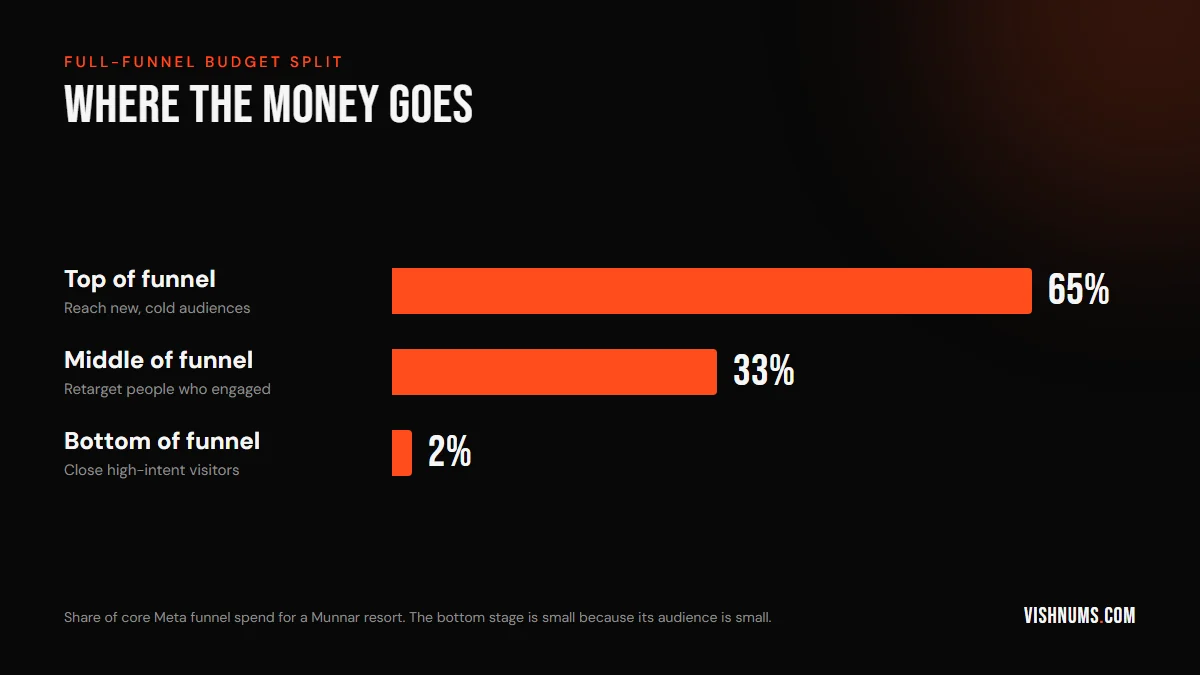
Stage 1: top of funnel (65% of budget)
Broad reach to cold audiences: people interested in Munnar, hill stations, weekend trips, honeymoons and family holidays. The creative was simple: the property, the view, the experience. The job of this stage is to fill the pipeline cheaply.
Stage 2: middle of funnel (33% of budget)
Retargeting people who engaged with the ads, watched videos or visited the website, with offers and property highlights: room types, packages, what is included. This is where interest becomes intent.
Stage 3: bottom of funnel (2% of budget)
Conversion-focused retargeting of the highest-intent visitors. Small audience, small budget, but this stage closes bookings that would otherwise leak to an OTA.
Prospecting fills the funnel. Retargeting and fast follow-up turn it into bookings.
The 65/33/2 split surprises people. You might expect to spend most on the people closest to booking, but those audiences are small. The real lever is keeping enough fresh people entering the top so the retargeting pools never dry up.
Google Search for high-intent demand
Meta creates demand. Google captures demand that already exists. We layered Google Search on top for searches like "resort with private pool Munnar", where the traveller has already decided what they want.
Over the period, impression share on key search terms grew from 5% to 12%. In August alone, Google Ads produced 487 conversions at ₹331 per conversion.
For keywords, budgets and match types, see my guide to Google Ads for resorts in Kerala.
The part most agencies skip: CRM follow-up
Ads do not make bookings. People do. Every lead flowed straight into the resort's CRM (TeleCRM) with a clear status pipeline:
- 01Fresh: a new lead, not yet called
- 02Interested / Ringing: in conversation
- 03Won or Lost: the outcome, recorded
The tele-calling team worked the freshest, hottest leads first. Because every lead had a status, it was obvious where enquiries were being lost, and the team could fix the process rather than blame the ads.
This is also what makes the ROAS figure defensible. Revenue is not a Meta estimate. It is the booking value the resort's own team recorded against each won lead.
It also exposed the next problem to fix: most leads arrived without a channel tag, so the CRM could not say which ad produced them. Closing that gap is now part of the work, because a return you cannot attribute is a return you cannot scale.
What the monthly numbers showed
- Google converts better, Meta fills the pipe. Google Ads turns 5.6% of its leads into bookings against 1.7% for Meta, yet Meta supplies most of the volume. Both return over 3x.
- CPMs rose from about ₹45 in March to about ₹91 in July as competition increased. The funnel stayed profitable because the booking value held.
- July and August saw more leads marked Lost, the natural trade-off of a bigger top of funnel. The team used that signal to tighten lead qualification.
A checklist for your resort
If you run a resort or homestay in Kerala, here is where I would start:
- 01Track bookings, not likes. Connect every lead to a CRM, or at least a shared sheet with a Won/Lost status and booking value. Then send those bookings back to Meta so it finds more guests who book.
- 02Build three audiences, not one: cold prospects, engaged people, and high-intent visitors.
- 03Keep the top of funnel always on. Seasonal bursts reset your retargeting pools to zero.
- 04Reply in minutes, not hours. Speed of response decides hospitality bookings.
- 05Add Google Search for your highest-intent phrases: your location plus "resort", "private pool", "honeymoon" or "family".
- 06Calculate your real ROAS from booking value in your own records, not from what Meta reports.
For what these campaigns cost month by month, see Meta Ads cost in India (2026).
Want this for your property?
I run Meta Ads and Google Ads for hospitality brands, and I build the websites and booking pages the traffic lands on. If you want a funnel like this for your resort, request a quote and tell me about your property.
Ads, a website that converts, or both: get a custom quote.