Advantage+ Sales Campaigns for Small D2C Brands in India: When to Use Them and When Not To
Meta now pushes Advantage+ automation on every sales campaign. For a small Indian D2C brand it can help or quietly waste money. What it changes, when it works, and how to test it fairly.

If you've created a sales campaign on Meta recently, you'll have noticed that Advantage+ is switched on almost everywhere by default: Advantage+ audience, Advantage+ placements, Advantage+ creative. Meta's message is simple: let the algorithm decide, and results will improve.
Sometimes they do. For a small Indian D2C brand with a modest budget and messy data, automation can also spend money on the wrong people while the dashboard looks fine. Here's how to decide.
What Advantage+ actually changes
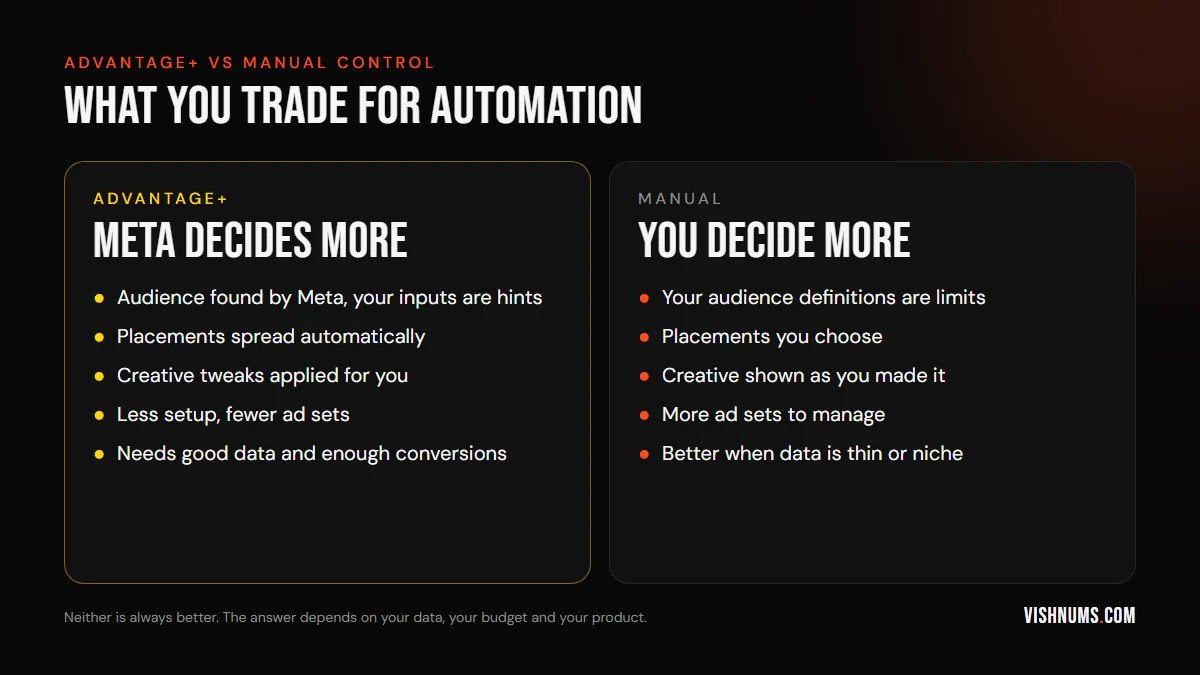
Audience. With Advantage+ audience, your age, interest and location choices become suggestions. Meta can go beyond them if it thinks it'll find buyers there. Location still acts as a hard limit.
Placements. Your ads can appear across Facebook, Instagram, Messenger and the Audience Network, wherever Meta finds them cheapest.
Creative. Advantage+ creative can apply enhancements to your ads: adjusting brightness, adding music, cropping images, generating text variations. Some are fine. Some change your ad in ways you wouldn't approve.
Structure. Fewer, broader campaigns with more budget in each, so the algorithm has more data to learn from.
When Advantage+ tends to work
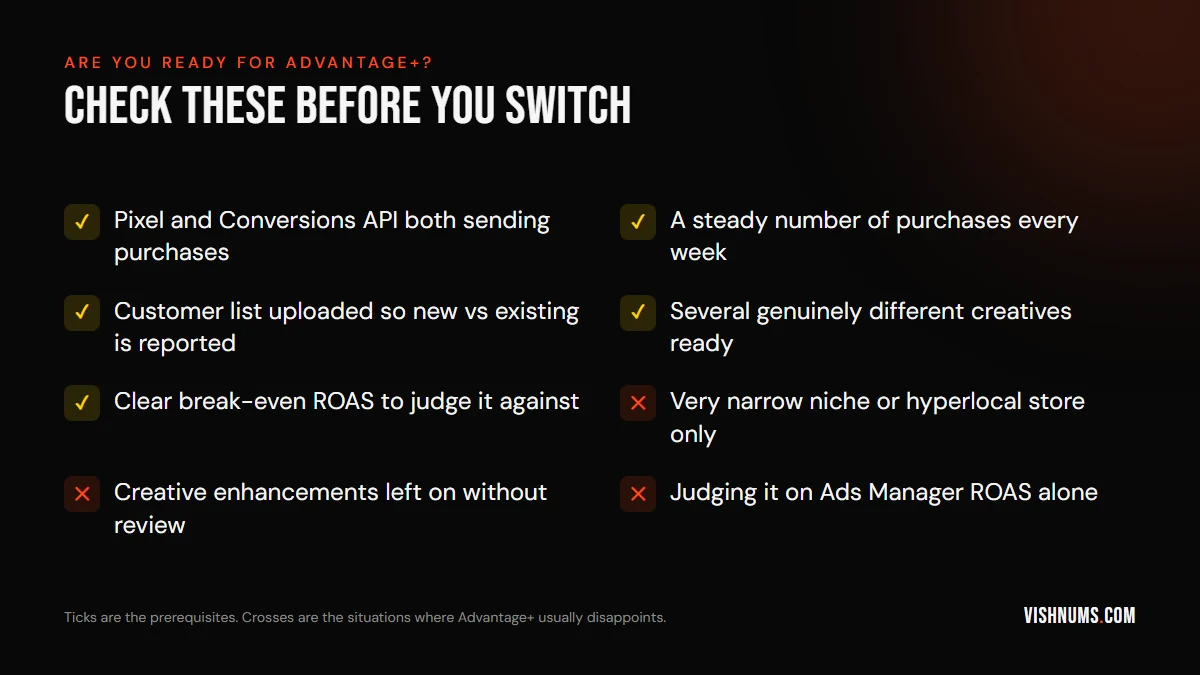
- Your tracking is solid. The pixel and the Conversions API are both sending purchases with values. If Meta gets bad data, automation optimises toward the wrong thing.
- You have enough conversions. Automation learns from volume. A store with a steady flow of weekly purchases gives it something to work with. See learning limited on small budgets for what happens without it.
- Your product has broad appeal. Skincare, apparel, home goods and gifts sell to wide audiences, which is where Meta's targeting does best.
- You have creative variety. Advantage+ finds people through the creative. Five versions of the same image give it nothing to work with. Different angles, formats and hooks do.
When manual control is better
- Very narrow or hyperlocal products. A jeweller with one store in Thrissur doesn't need ads in Kolkata. Location limits help, but broad delivery within a large area still needs watching.
- Thin data. A new brand with a handful of sales a week often gets more from a tightly defined audience and simple structure until volume builds up.
- High RTO on COD. If Meta counts COD orders that never deliver, it'll find more buyers who refuse parcels. Fix the signal first. See how to reduce RTO on COD orders.
- Brand-sensitive creative. Review or switch off creative enhancements if music, cropping or AI text could misrepresent your product.
Separate new and existing customers
One common problem: Advantage+ spends a large share of budget on people who already know you or have bought before. They're cheap to convert, so ROAS looks great, but you aren't growing.
Upload your customer list and set up audience segments in your ad account settings, so reporting shows how much spend and revenue came from new versus existing customers. If most results come from existing customers, your "great ROAS" is mostly people who'd have bought anyway.
How to test Advantage+ fairly
Don't switch everything at once. Run a controlled comparison:
- 01Keep your current best campaign running.
- 02Launch an Advantage+ version with the same creatives and a similar budget.
- 03Run both for at least two to three weeks. Shorter tests are mostly noise.
- 04Judge on new-customer revenue and delivered revenue, not just Ads Manager ROAS.
- 05Compare both against your break-even ROAS. My break-even ROAS guide for Indian D2C brands explains how to calculate it with GST, COD and RTO.
Meta's built-in A/B testing tool can split audiences fairly between the two versions, which is cleaner than running them side by side.
Catalogue ads and Advantage+
If you run a Shopify store with many products, dynamic catalogue ads inside an Advantage+ sales campaign often work well, because Meta matches products to people automatically. Setup and catalogue health matter more than any toggle. See dynamic catalogue ads for Shopify stores in India.
Frequently asked questions
Is Advantage+ good for small businesses in India?
It can be, if tracking is solid, purchases are steady and you have varied creative. For very small or niche brands with little data, a simpler manual setup often works better at first.
Should I turn off Advantage+ creative enhancements?
Review them. Turn off any that change your product's look or add text you wouldn't write, especially for jewellery, fashion and beauty, where accuracy matters. For high-value pieces, see Meta ads for bridal jewellery.
How do I know if Advantage+ is working?
Compare it with your existing campaign over two to three weeks, judging on new-customer revenue and delivered revenue against your break-even ROAS. Ads Manager ROAS alone can mislead.
Want an honest test of Advantage+ on your account? Request a quote.
Ads, a website that converts, or both: get a custom quote.