Meta Ads “Learning Limited” on a Small Indian Budget: What It Means and What to Do
Learning Limited is not an error, it is arithmetic. Here is the simple budget calculation that predicts it, and five fixes for small Indian ad accounts that cannot afford 50 purchases a week.

You launch a campaign, check Ads Manager the next week, and see two words next to your ad set: Learning Limited. It sounds like a warning that something is broken. It isn't. It's Meta telling you, in its own way, that the arithmetic doesn't work.
This is one of the most common things I see in small Indian ad accounts, and it's usually fixable without spending more money.
What the learning phase is
Whenever you create a new ad set or make a significant change, Meta's delivery system enters a learning phase. It's working out who to show your ads to, where and when, to get the result you've asked for.
Meta says an ad set generally needs about 50 optimisation events within 7 days to exit learning. An "optimisation event" is whatever you told the campaign to get: a purchase, a lead, an add to cart, a message.
Learning Limited means Meta predicts your ad set won't get that many events, so performance will stay less stable than it could be.
The arithmetic that causes it
Here's the calculation most advertisers never do:
Events per week = weekly budget ÷ cost per event
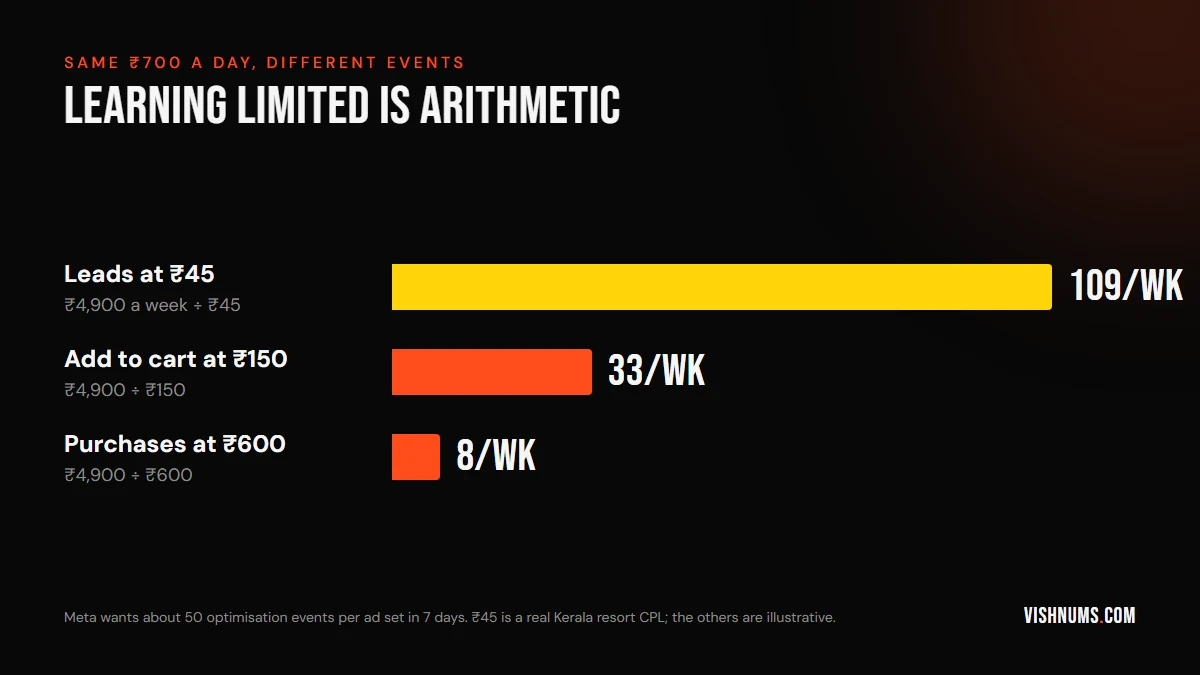
Take a ₹700 daily budget, or ₹4,900 a week:
- If you optimise for leads at ₹45 each (the blended cost per lead a Kerala resort I work with averaged in 2026), you get about 109 a week. Comfortably out of learning.
- If you optimise for add to cart at ₹150, you get about 33. Close, but not there.
- If you optimise for purchases at ₹600, you get about 8. You'll be Learning Limited for as long as the campaign runs.
Same budget, same audience. The only difference is the event you asked for.
Is Learning Limited always bad?
No. Plenty of ad sets make money while Learning Limited. It means results are less predictable, and Meta has less room to optimise. If your cost per sale is fine and steady, you don't have to panic.
It becomes a problem when performance swings wildly from day to day, when costs creep up, or when you're spreading a small budget across many ad sets, each one too thin to learn anything.
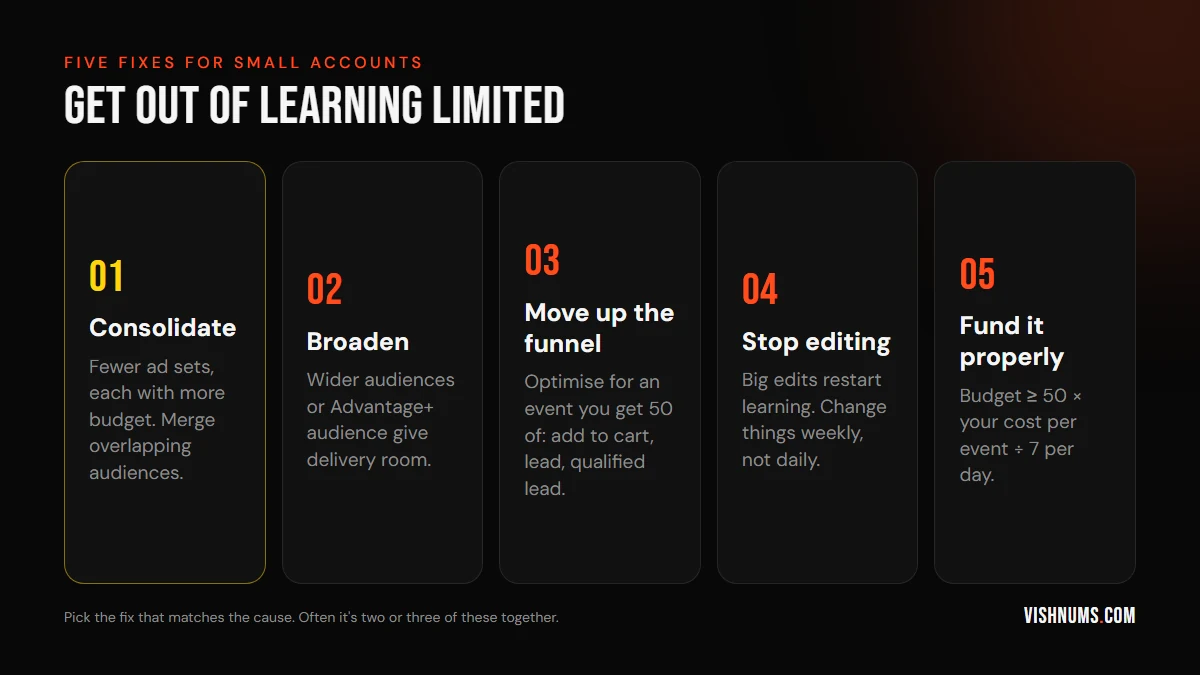
Five fixes for small budgets
1. Consolidate
This is the fix I use most. Small accounts often have five ad sets with ₹300 each: one per interest, one per age group, one per city. Each is starved. Merge them into one or two ad sets with the full budget, and let Meta find the people within a broader pool.
2. Broaden your audience
Very narrow audiences give Meta little room. Wider targeting, or Advantage+ audience, often helps an ad set exit learning, especially if your creative clearly shows who the product is for.
3. Optimise for an event you can get 50 of
If you can't afford 50 purchases a week, optimise for something earlier that you can get enough of: add to cart, initiate checkout, or a lead. Then judge the campaign on purchases and revenue anyway. For lead businesses, sending a qualified-lead stage from your CRM gives you a middle option. Here's how to send CRM stages to Meta.
4. Stop editing so often
Significant edits, like big budget changes, new creative, changes to targeting or bid strategy, or pausing for a long time, can restart the learning phase. Make changes in batches, once a week, rather than tweaking every day.
5. Fund the ad set properly
A simple rule of thumb for the daily budget an ad set needs:
Daily budget ≈ 50 × cost per event ÷ 7
If your cost per purchase is ₹600, that's about ₹4,300 a day per ad set. If that's more than you can spend, fixes 1 and 3 matter more than budget.
What not to do
- Don't duplicate an ad set to "reset" it. You restart learning and split your data.
- Don't keep launching new campaigns every time results dip. Each one starts learning from scratch.
- Don't judge an ad set after two days. Give it at least a week, unless it's clearly broken.
- Don't cut your budget in small, frequent steps. Each big change can unsettle delivery.
How I structure small accounts
For most small Indian businesses spending a few lakh a month or less, a simple structure works best:
- One prospecting campaign with one or two broad ad sets and several creatives.
- One retargeting campaign for website visitors and engaged users. Here's how to set retargeting windows.
- Each ad set funded well enough to get regular results.
Fewer moving parts, more data per ad set, and more stable results. If you want a full review of your account's structure, my Meta Ads audit checklist covers it.
Wondering whether Advantage+ fixes this? Sometimes it does. Here's when Advantage+ sales campaigns suit small D2C brands and when they don't.
Frequently asked questions
What does Learning Limited mean on Meta Ads?
It means Meta predicts your ad set won't get enough optimisation events (around 50 in 7 days) to exit the learning phase, so delivery and costs may stay less stable.
How do I get out of Learning Limited?
Combine ad sets, broaden targeting, optimise for an event you get more of, avoid frequent big edits, or increase the budget so it can reach about 50 events a week.
Can a Learning Limited ad set still be profitable?
Yes. If your cost per sale is acceptable and steady, it can keep running. Learning Limited is a signal to consider, not a reason to switch off a campaign that's working.
Running a small budget and stuck in learning? Get in touch and I'll take a look at your account structure.
Ads, a website that converts, or both: get a custom quote.