Getting Facebook Leads But No Sales? An 8-Point Diagnosis
Cheap leads that never buy are the most common complaint about Meta Ads in India. Here are the eight places the funnel usually breaks, in the order to check them, with real lead-to-sale rates for comparison.
"We get plenty of leads from Facebook, but nobody buys." I hear this from businesses across Kerala and India every month. The usual reaction is to blame the leads, change the targeting, or stop running ads.
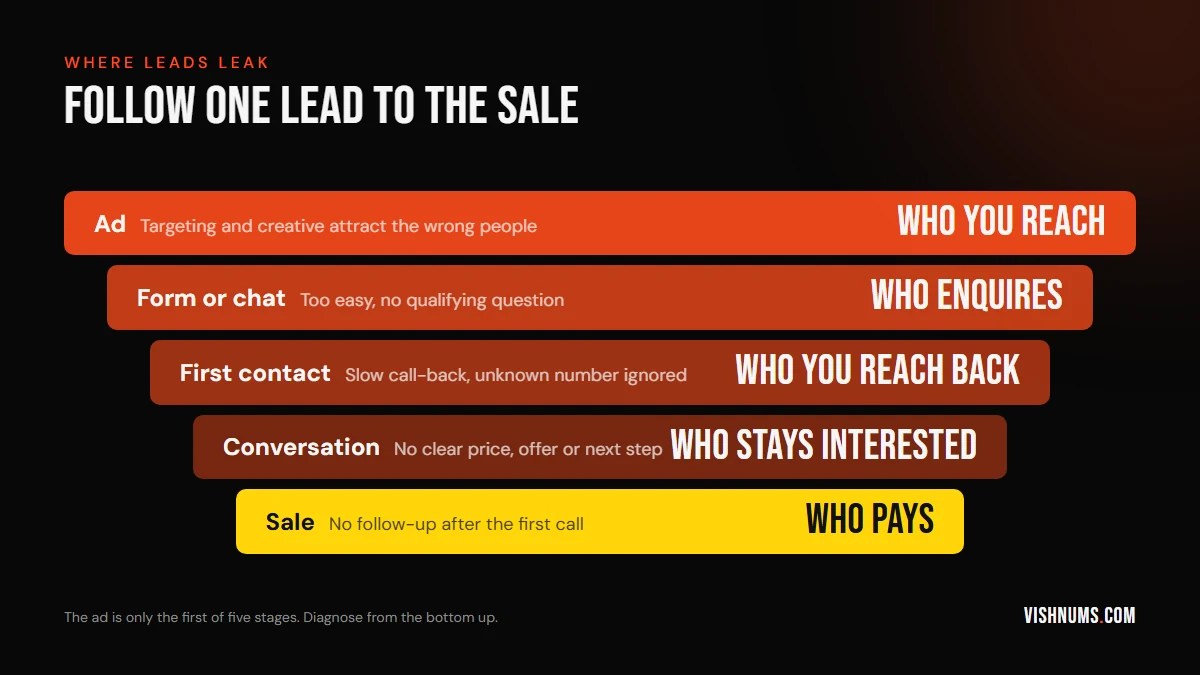
Usually the leads aren't the whole problem. A lead is the start of a sale, not the sale. Between the form and the payment there are several stages, and the break is often in one nobody is looking at.
First, what's a normal lead-to-sale rate?
You need a reference point. For the Munnar resort I run ads for, across 2026:
- Meta leads converted to bookings at 1.7%.
- Google Ads leads converted at 5.6%.
So even in a well-run account with a dedicated tele-calling team, most Meta leads don't book. If you're getting a 1% or 2% lead-to-sale rate from Meta in a considered category, that may simply be normal. You might not have a lead quality problem at all. You might have a pricing problem, a cost-per-lead problem, or a measurement problem.
The resort's numbers still worked: October 2026 returned 5.9x on ad spend, because the leads were cheap enough and the follow-up was disciplined. See the case study.
Where leads leak
Real estate is the clearest example: cheap form leads, very few site visits. I break that down in Meta ads for real estate in Kerala.
The 8-point diagnosis
Work through these in order. The first few are the most common causes, and the cheapest to fix.
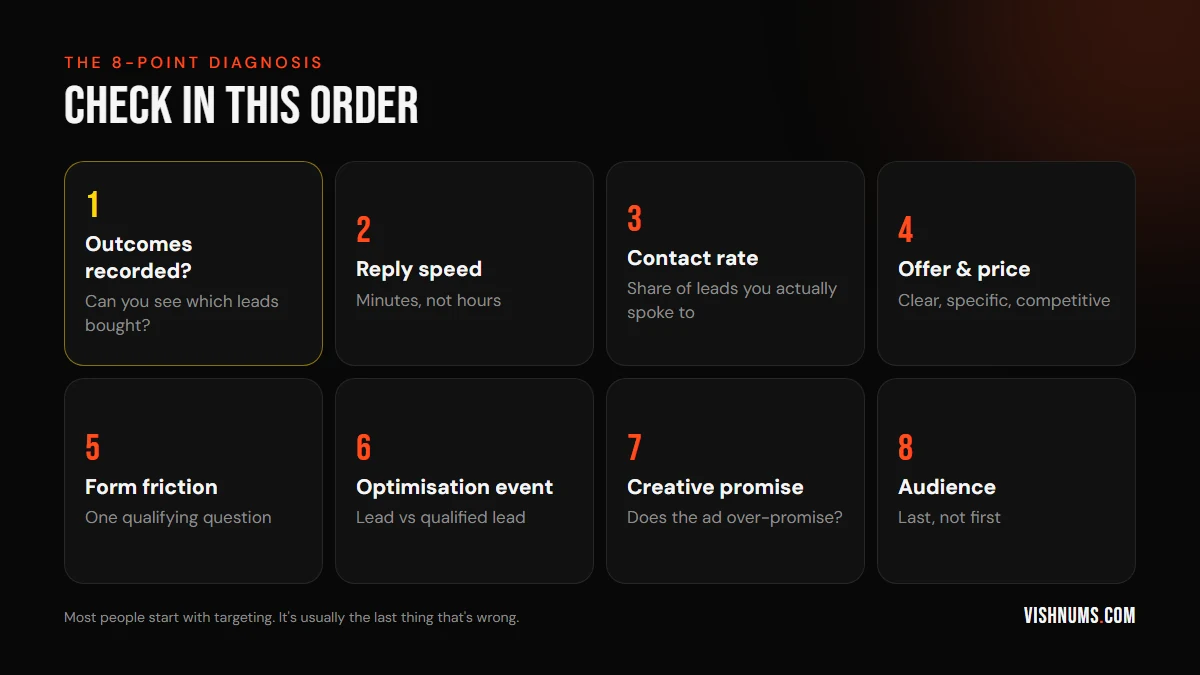
1. Are you recording outcomes?
If you don't know which leads bought, you can't know which campaigns work. Put every lead in a CRM or sheet with a final status: Won or Lost, with a reason. This alone often reveals the problem. If most "lost" reasons are "not reachable", the problem is contact, not quality.
2. How fast do you reply?
A lead contacted the next day is often a dead lead. People enquire with several businesses at once and go with whoever responds first and clearly. Aim to call or message within minutes during business hours, and cover evenings and weekends, when many people browse.
3. What share of leads do you actually reach?
Many people in India don't answer unknown numbers. If you only call, you might be reaching less than half your leads. Follow every missed call with a WhatsApp message saying who you are. Retry at different times of day.
4. Is the offer clear and competitive?
If people enquire but drop off after hearing the price, the ad is attracting people outside your price range. Show a "starting from" price in the ad, so people who can't afford it don't enquire. Fewer leads, but better ones.
5. Is the form too easy?
Instant forms with pre-filled details are so quick that people submit them without much thought. Add one qualifying question (dates, budget, city, timeline), or switch to the "higher intent" form type, which adds a review screen. Lead costs go up, and quality usually goes up too. Industry examples of the right questions to ask: coaching centres and interior designers.
You can also compare forms with click-to-WhatsApp. Here's how the two compare in India.
6. What is Meta optimising for?
If your campaign optimises for "Lead", Meta finds people who fill forms. If you send your CRM outcomes back to Meta, it can find people who buy. Here's how to send CRM bookings to Meta through the Conversions API.
7. Does the ad over-promise?
Big discounts, "free" offers and vague hooks attract curiosity clicks. If the ad says "Get a free quote!" and the reality is a ₹50,000 service, many leads will be surprised by the price. Make the ad honest about what you sell and who it's for.
8. Is the audience wrong?
Only now look at targeting. Check the leads' locations and ages in your CRM against your real customers. Exclude areas you can't serve. If you use very broad targeting, make sure your creative itself filters the audience: show the product, the price range and the customer it's for.
For online stores: when you get traffic but no sales
The same logic applies if you sell online and get clicks but few purchases:
- Check that your purchase tracking works and that Meta is optimising for purchases, not clicks or landing page views.
- Check the landing page: speed on mobile, price clarity, shipping costs, trust signals.
- Check checkout: extra steps, forced account creation, limited payment options or no COD option where your customers expect it.
- Check your numbers: if your margin is thin, sales might be happening but at a loss. Work out your break-even ROAS.
A simple weekly report that catches problems early
Every week, look at:
- Leads by campaign
- Share contacted within an hour
- Share reached at all
- Sales by campaign
- Cost per sale by campaign
- The top three lost reasons
When one of these moves, you'll know where to look, instead of guessing and changing the targeting again.
Frequently asked questions
Why are my Facebook leads not converting?
The most common causes are slow follow-up, low contact rates (people not answering unknown numbers), unclear pricing, forms that are too easy to submit, and campaigns optimised for leads rather than sales. Targeting is usually not the main problem.
What is a good lead-to-sale rate for Facebook ads?
It varies widely by industry. For a Kerala resort with a dedicated sales team, 1.7% of Meta leads became bookings in 2026, against 5.6% for Google Ads leads. Judge your rate against your cost per lead and your margin, not against a generic benchmark.
Should I stop using lead forms?
Not necessarily. Add a qualifying question, use the higher-intent form type, improve follow-up speed, and compare forms with click-to-WhatsApp on cost per sale before deciding.
If your leads aren't turning into sales and you'd like a second pair of eyes, get in touch.
Ads, a website that converts, or both: get a custom quote.