Meta Ads for Home Builders and Contractors in Kerala: Leads From People Ready to Build
How Kerala home builders and contractors can use Meta ads to find plot owners ready to build: qualifying forms, NRI campaigns, trust-building site content, winning quotes and months-long follow-up.

Building a house is the biggest purchase most Kerala families ever make. It's planned for years, financed with savings, Gulf earnings and home loans, and discussed endlessly in family WhatsApp groups. Families choose a builder slowly and carefully, and they've all heard stories about contractors who disappeared halfway through a job.
That makes Meta ads hard for construction companies. Facebook and Instagram are excellent at finding people who enjoy looking at beautiful houses, and poor at telling you which of them have a plot, an approved plan and a budget. Without a plan, your sales team spends its week calling people who are years away from building.
This guide is for home construction companies, building contractors and turnkey builders in Kerala. It covers how to tell dreamers from buyers, how to qualify leads in the form, how to reach NRI families building from abroad, what content builds trust, how to write a quote that wins, and how to follow a decision that takes months.
Key takeaways for builders
- Most people engaging with house content are at the "dreaming" stage. Your ads and forms must sort them out.
- Ask about plot ownership, plan status, built-up area and start date in the form.
- Run a separate campaign for NRI families, who build a large share of Kerala homes from abroad.
- Show finished homes and live sites, not 3D renders.
- Publish itemised rates and stage-wise payments; transparency is your strongest advertisement.
- Follow up over months, and send signed contracts back to Meta as conversions.
Understand the stages of a house-building decision
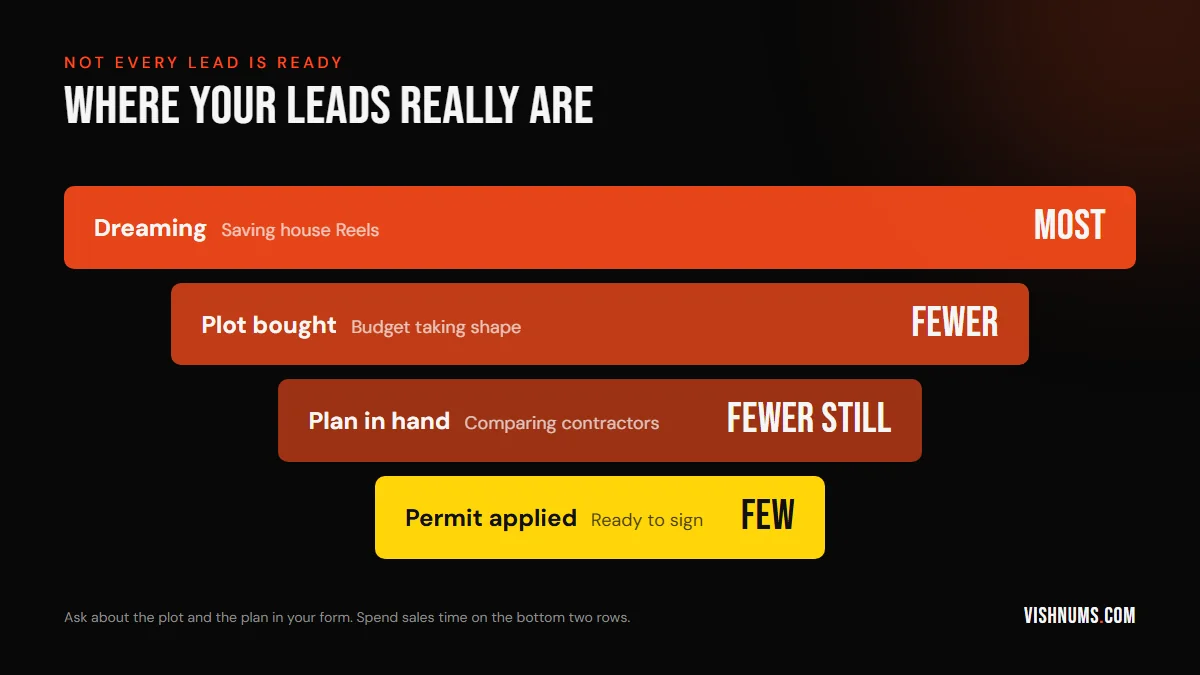
Contemporary Kerala house designs, box-type elevations, traditional nalukettu-style homes and courtyard plans get huge engagement on Instagram. But engagement isn't buying. A house-building decision usually moves through these stages:
- 01Dreaming: saving designs, following architects, imagining a future house.
- 02Plot bought or inherited: the budget starts becoming real, often tied to a home loan.
- 03Plan in hand: an architect or draughtsman has drawn plans, and the family is comparing contractors.
- 04Permit applied or approved: the family needs a builder soon.
A contractor makes money from stages three and four. Stage two is worth nurturing. Stage one can buy your design consultancy, if you sell that, but shouldn't take your site engineer's time.
Qualify with the form
The single biggest improvement most builders can make is a better lead form. Use Meta's Higher intent instant form type, or a short landing page, with questions like these:
- 01Do you own a plot for this house? Yes / Buying one soon / Not yet.
- 02Do you have a building plan? Approved plan / Being drawn / Not yet.
- 03Approximate built-up area? Under 1,200 sq ft / 1,200–2,000 / 2,000–3,000 / Above 3,000.
- 04When do you want to start construction? Within 3 months / 3–12 months / Later.
- 05Where is the plot? District or town.
- 06Are you currently living abroad? Yes / No.
Fewer people complete this form, and that's the goal. Sort the leads as they arrive:
- Plot + plan + start within 3 months: call the same day, offer a meeting and a visit to an ongoing site.
- Plot but no plan: offer planning help or a referral to architects you work with. These become strong leads in a few months.
- No plot: add to a monthly WhatsApp nurture with finished-home walkthroughs. Don't send them to your sales team.
If your company also does interiors, keep that as a separate campaign with its own message; the timing and buyer differ. See Meta ads for interior designers in Kerala.
Targeting that works for builders
You don't need complex audiences. What matters:
- Location: the districts where you actually build, plus where your NRI customers live (see the next section). Building across the state with one site team is hard to deliver well.
- Age: families building homes tend to be in their 30s to 50s, but test broad age ranges; Meta often finds the right people when the creative is specific.
- Broad targeting with qualifying creatives. A Reel titled "What we check before pouring the roof slab" attracts people who are about to build, not dreamers scrolling for pretty elevations.
Retarget people who watched most of your site videos or visited your website. House decisions take a long time, so keep those audiences for months. Retargeting windows for high-ticket products explains how long to keep them and how to change the message over time.
Reach NRI families building from abroad
Gulf earnings pay for a large share of new Kerala homes. The money and the decision often sit in Dubai, Doha, Riyadh or Muscat, while parents or siblings supervise locally. These families have one overriding fear: being cheated from a distance.
Run a separate campaign for them:
- Locations: the Gulf countries where people from your district typically work, plus any other country with a large community from your area.
- Timing: before Gulf summer holidays and around Onam and Christmas, when families come home and meet builders in person.
- Message: remote progress updates, weekly photo and video reports, stage-wise payments, a named site supervisor, and a meeting or site visit scheduled during their next trip home.
Offer a video call with your site engineer as the call to action. Many NRI families shortlist builders from abroad and finalise during a short visit. The targeting setup is explained in how to target NRIs in the Gulf with Meta ads.
Content that wins a family's trust
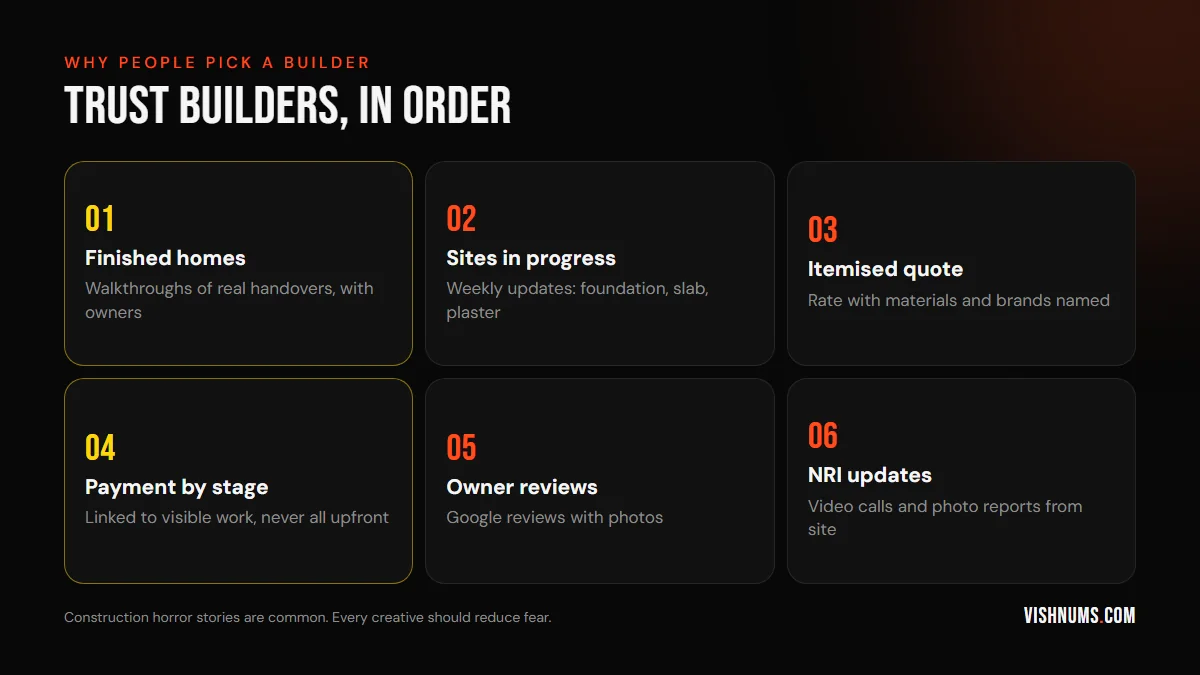
Everyone has attractive renders. Very few builders show finished, lived-in homes and honest construction progress. That's your opening.
Handover walkthroughs
A two-minute video walking through a finished house with the owners, in Malayalam, talking about what it was like to build with you. Ask about the budget, delays and how problems were handled. Authentic answers beat polished scripts.
Progress series
Film the same site from foundation to key handover and post it as a series: foundation, plinth beam, walls, roof slab, plastering, flooring, painting. People follow along, and each episode shows you work properly. It also helps search, as people look up "house construction stages in Kerala" before building.
Quality details
Short Reels on things families worry about: curing the slab, waterproofing before the monsoon, the steel and cement brands you use, how you handle termite treatment. Each one answers a real question and quietly shows your standards.
The team
Show your site engineer and supervisors by name. Families want to know who will be on site.
Write a quote that wins
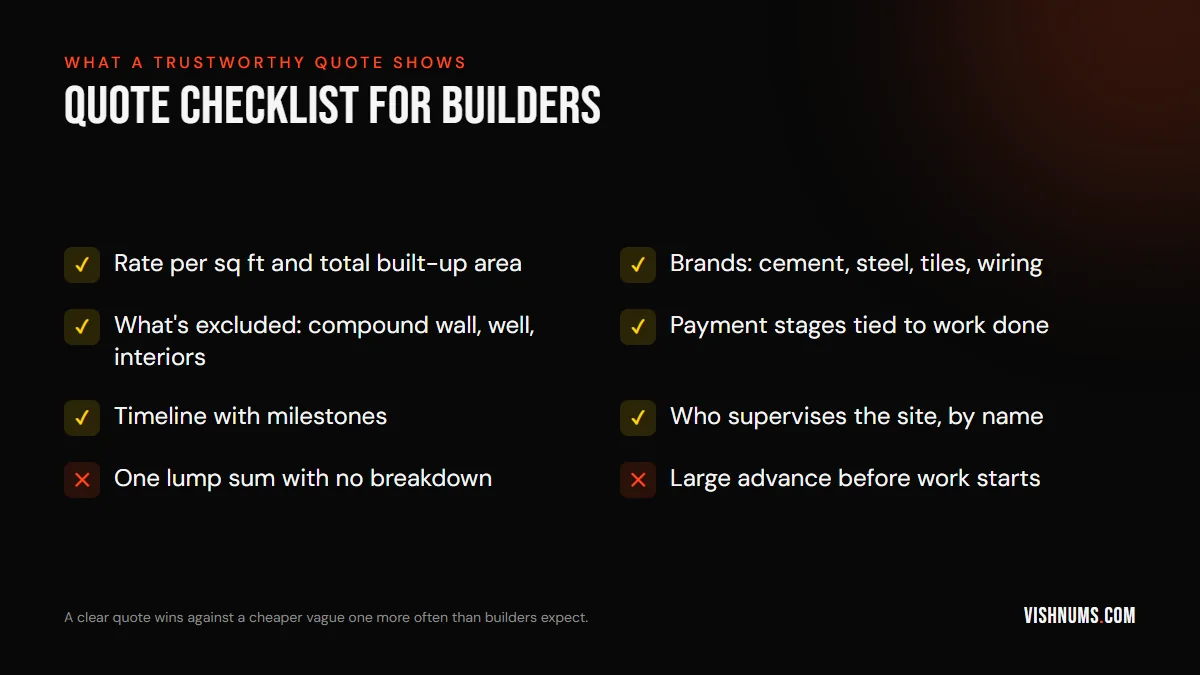
Your quote is part of your marketing. Families compare three or four quotes, and the cheapest vague quote often loses to a slightly higher clear one, because people suspect hidden costs.
A strong quote includes:
- Rate per square foot and total built-up area, with how area is measured.
- Named brands and grades for cement, steel, tiles, electrical wiring, plumbing and doors.
- What's excluded: compound wall, well or borewell, interiors, landscaping, permit fees. Exclusions discovered later destroy trust.
- Payment stages tied to visible work: foundation, plinth, roof slab, plastering, flooring, handover.
- A timeline with milestones, including realistic allowances for the monsoon.
- The named site supervisor and how often you'll send updates.
You can even advertise the quote format itself: "See exactly what you pay for: our itemised quote, brand by brand." That alone sets you apart.
The follow-up is where the sale happens
House-building decisions take weeks or months. A builder who calls once and waits rarely wins. Build a simple follow-up rhythm:
- Day 0: call within a few hours, confirm plot and plan details, and invite them to a site visit.
- Day 1: send a WhatsApp message with two finished-home videos and your quote format.
- Week 1: after the site visit, send the itemised quote.
- Week 2: follow up on questions; offer a call with your engineer.
- Monthly after that: send progress updates from your current sites, until they decide.
Keep notes on every lead: plot location, plan status, family decision-makers, budget concerns. Those notes let anyone on your team pick up a conversation without asking the family to repeat themselves. How to follow up enquiries has a detailed follow-up cadence that adapts well to construction.
Twelve content ideas for the next three months
Consistency matters more than production quality. One honest video a week, filmed on a phone, beats a slick brand film once a year. Here are twelve ideas you can film on your current sites:
- 01"Why we cure the slab for this long": a 30-second explanation filmed on a fresh roof slab.
- 02Steel and cement brands we use, and why: hold up the bags and bars, talk about grades.
- 03Waterproofing before the monsoon: show the process on a terrace or bathroom.
- 04A day on site: time-lapse from morning arrival to evening wrap-up.
- 05Owner interview at handover: what surprised them, what they'd tell other families.
- 06How we handle changes mid-way: a family wanted a bigger window; how the cost was agreed in writing.
- 07Plumbing and wiring before plastering: why concealed work is checked and photographed.
- 08Common mistakes in house plans: your engineer reviewing a plan (with permission) and pointing out issues.
- 09Termite treatment explained: when it's done and why it matters in Kerala's climate.
- 10What a stage payment looks like: the work completed before each payment is requested.
- 11NRI update sample: the actual weekly photo report you send to families abroad.
- 12Before the key handover: the snag list your team checks before the family moves in.
Each idea answers a question that families about to build are actively asking. That's why this content attracts the right people, and why it can be reused as ads when a video performs well organically.
Don't forget search and Google Business Profile
Many families research builders on Google after seeing your ad, or search "home builders in [town]" directly. Make sure what they find supports your ads:
- Google Business Profile with the right category, service areas, dozens of photos of real projects, and reviews from past clients with photos. Reply to every review, including negative ones, calmly and specifically.
- A simple website with a projects page, your rate structure, stage payments explained, and contact options. It doesn't need to be large, but it must look current.
- Project pages by location: "3-bedroom house in Kottayam, 1,850 sq ft" with photos and a short story. These pages often rank for local searches and give your ads something credible to link to.
Many of the principles in Google Business Profile for resorts and homestays apply directly to builders: photos, categories, review replies and regular posts.
Handling the price question
Almost every lead asks "What's your rate per square foot?" in the first message. How you answer decides whether the conversation continues.
Don't refuse to answer; that feels evasive. Don't give one number with no context either; people compare it with a lower number from someone else and leave. Instead, give a range and explain what moves it:
"Our rate for most houses is between ₹[X] and ₹[Y] per sq ft, depending on the elevation, flooring and fittings you choose. That includes [brands of cement, steel and wiring]. It doesn't include the compound wall or interiors. If you share your plan, we'll send an itemised quote within three days so you can compare properly."
This answer does three things: it's honest, it shows the quote will be detailed, and it moves the lead to sharing their plan, which is the next step in your sales process.
Home loans and timing
Many families depend on a home loan, and loan sanction timing affects when construction can start. Talk about this in your content:
- Which documents banks typically ask for at each stage.
- How stage-wise payments line up with loan disbursements.
- Why an itemised estimate from the builder helps with loan processing.
A short Reel explaining this, or a downloadable checklist, helps families who are at the "plot bought" stage and moves them closer to choosing you. Avoid giving financial advice; explain the process and recommend they speak to their bank.
Plan around the monsoon
Kerala's monsoon shapes the construction calendar. Families often want to start foundations before the rains or plan roof slabs for drier months. Use this in your advertising:
- In the months before the monsoon, run ads aimed at families who want to start foundation work before the rains.
- During the monsoon, focus on planning, quotes and permits, so construction can start as soon as it's dry. Show waterproofing and how you protect ongoing sites.
- After the monsoon, push for families ready to start immediately.
Planning content this way also shows expertise. A builder who explains how they handle rain is far more convincing than one who never mentions it.
Measure what matters
Cost per lead is a weak measure for builders. A ₹150 lead from a dreamer is worthless; a ₹1,500 lead from a plot owner with an approved plan might become a contract.
Track these by campaign and by ad, weekly:
- Leads received
- Qualified leads (plot + plan or near it)
- Site visits or office meetings
- Quotes sent
- Contracts signed
Put the stages in a shared sheet or a CRM. When you have a few signed contracts, send those events back to Meta through the Conversions API so the system learns what a real buyer looks like. The method is in sending CRM results to Meta's Conversions API.
What a contract costs in ads
The figures below are hypothetical, there only to make the arithmetic concrete.
Suppose a builder spends ₹40,000 a month and gets 80 leads (₹500 each, which is realistic with a demanding form). Twenty-five are qualified. Ten agree to a site visit. Four receive quotes and one signs a contract in the following two months.
That's ₹40,000 of ads for one contract, plus some pipeline for future months. For a house worth many lakhs, the ad cost is small compared with the margin. Most builders find their real limit is site capacity and supervision quality, not ad cost. Grow ad spend only as fast as you can deliver well, because one bad project in a small town can undo years of good reviews.
Signs a lead is close to signing
Your team's time is limited, so learn to spot the leads worth extra attention. Families close to signing usually:
- Share their approved plan, or ask you to review it, without being prompted.
- Ask detailed questions about materials, brands and payment stages rather than only the headline rate.
- Bring a second decision-maker to the meeting or add you to a call with family abroad.
- Ask to visit an ongoing site, not just a finished house.
- Mention a loan sanction, a muhurtham date for starting, or a target date for moving in.
When you see two or three of these, prioritise that family: send your best engineer to the meeting, follow up within a day, and make the next step easy.
Mistakes that cost builders contracts
- Running render-only creatives that attract dreamers.
- Easy forms with just name and phone number.
- Advertising "starting from ₹X per sq ft" with a low number that becomes much higher in the quote. People feel tricked, and they talk.
- One campaign for local and NRI families, with a message that suits neither.
- Slow responses. Families shortlist builders who reply quickly and professionally.
- Ignoring Google reviews. Families read them closely; reply to every one.
- No content during the monsoon. It's a great time to show waterproofing and how you protect sites from rain.
A three-month rollout
Month one: set up a qualifying form, launch three creatives (handover walkthrough, progress Reel, quote transparency), restrict locations to where you build, and track leads by stage.
Month two: start the NRI campaign, add retargeting for site-video viewers, and refine your follow-up rhythm based on where leads drop.
Month three: send signed contracts and site visits back to Meta, shift budget towards ads with the best cost per qualified lead, and ask recent clients for video testimonials.
Frequently asked questions
How do building contractors get leads in Kerala?
Meta ads with qualifying forms (plot owned, plan ready, start date), separate campaigns for NRI families, real project content, a strong Google Business Profile with photo reviews, and referrals from past clients.
Why are my construction leads poor quality?
Usually because the ad and form are too easy and the creative is aspirational. Pretty renders attract dreamers. Add qualifying questions, show real projects, and talk about construction details serious builders care about.
Should builders advertise their rate per square foot?
Only if the rate is honest and clearly states what's included. A low headline rate that rises in the quote damages trust. An itemised rate with named materials works better.
How can a builder win NRI clients?
Run a separate campaign in Gulf countries, promise and deliver regular photo and video updates, offer stage-wise payments, and arrange site visits during their trips home.
How long does it take for builder leads to convert?
Often weeks or months. Keep in touch with qualified leads through regular updates from your sites until they're ready to sign.
Building homes in Kerala and want leads from people who own a plot? Request a quote.
Ads, a website that converts, or both: get a custom quote.