What Does a Performance Marketer Do? Skills, Tools and a Real Week in the Ad Account
A performance marketer runs paid campaigns for measurable results: leads, bookings and sales. Here is what the job really involves, the skills and tools it needs, and what a week inside a live account looks like.

"Performance marketer" is one of the most searched marketing job titles in India, and one of the least understood. Here is what the role actually involves, from someone who has done it since 2016.
The one-line definition
A performance marketer plans, runs and improves paid advertising campaigns that are judged on measurable results: leads, bookings, purchases and the revenue they produce.
Not likes. Not reach. Results you can find in the business's own records.
What a performance marketer is responsible for
1. Strategy and funnel structure
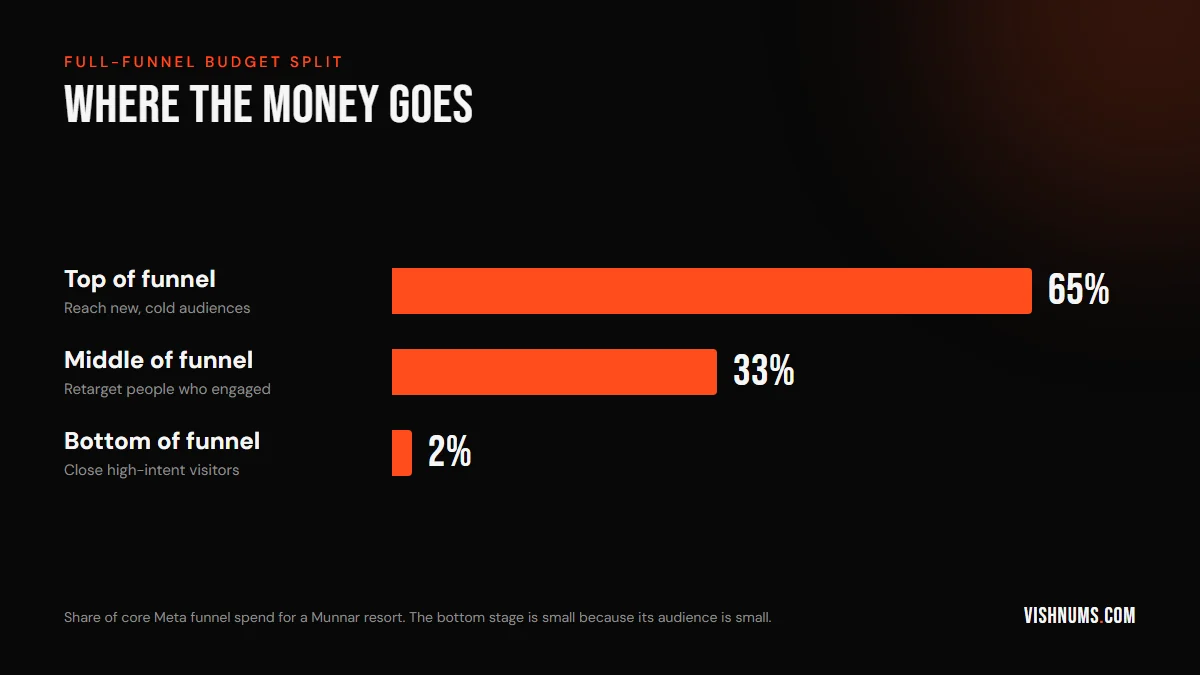
Deciding who to reach and in what order. Most accounts I run use a full funnel:
- Top of funnel (TOFU): reach new people who've never heard of the brand.
- Middle of funnel (MOFU): retarget people who engaged, with offers and proof.
- Bottom of funnel (BOFU): close the sale with the highest-intent visitors.
For a Munnar resort, the split was roughly 65% top, 33% middle and 2% bottom. The small bottom stage is not a mistake: those audiences are tiny, and the real lever is keeping enough new people entering at the top.
2. Campaign building
Setting up campaigns on Meta Ads (Facebook and Instagram) and Google Ads (Search, Shopping, Performance Max): audiences, budgets, bid strategies, placements and ad formats.
3. Creative testing
Ads wear out. A performance marketer keeps testing hooks, formats (Reels, carousels, static) and offers, and moves budget to whatever wins. One sign it's time for new ads: frequency creeping up while CTR falls.
4. Tracking and attribution
This is the part most people skip, and the part that matters most:
- Meta Pixel and Conversions API, so purchases and leads are reported reliably.
- GA4, linked to Google Ads.
- A CRM or store connection, so every lead gets an outcome: won or lost, and for how much.
Without this, you are guessing. See how to send CRM bookings back to Meta and GA4 tracking for hotel booking engines.
5. Budget allocation
Moving money daily or weekly toward what produces confirmed sales. Not clicks, not cheap leads that never buy.
6. Reporting
Turning the numbers into decisions: cost per lead, cost per sale, ROAS, and what to change next.
The metrics that matter
- CPL (cost per lead): spend ÷ leads.
- CPA (cost per acquisition): spend ÷ sales or bookings.
- ROAS (return on ad spend): revenue ÷ spend.
- Conversion rate: sales ÷ leads.
- CPM and CTR: cost per 1,000 impressions and click-through rate. They're useful diagnostics, but never the goal.
Real examples: a jewellery brand's top campaign returned 12.51x ROAS on Shopify revenue (case study). A resort generated leads at ₹45 each across Meta and Google, and in October turned ₹3.08L into ₹18.07L of bookings, a 5.9x month (case study).
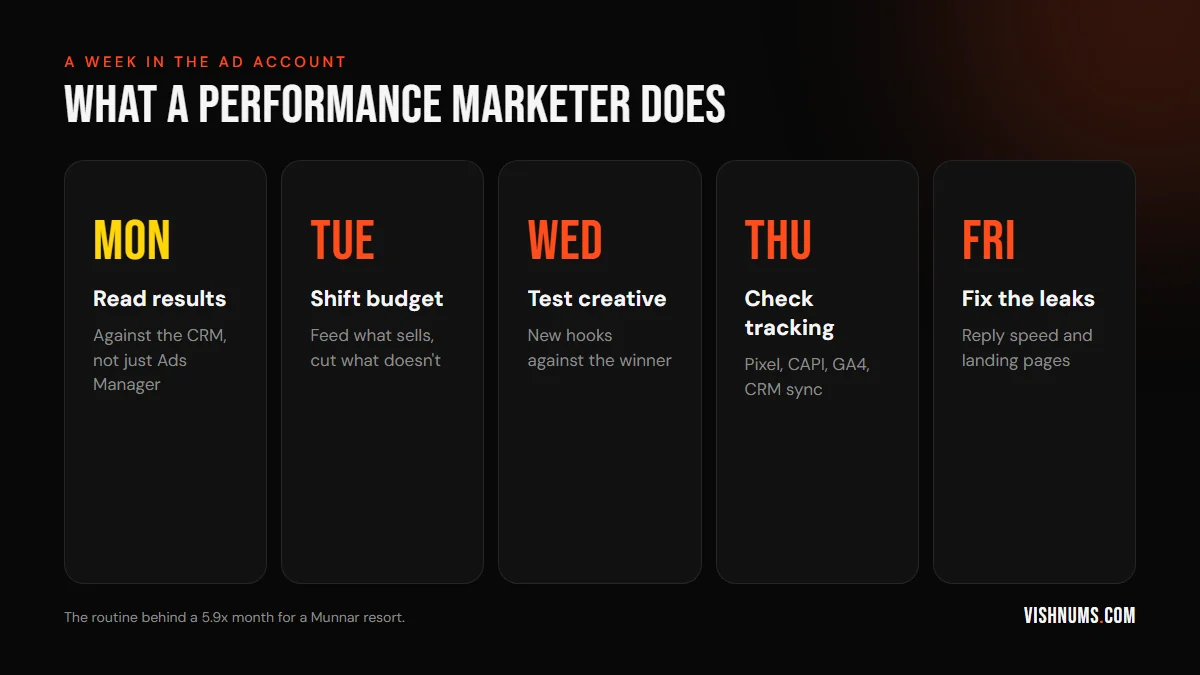
A real week in the account
Monday: read last week's results against the CRM, not just Ads Manager. Which campaigns produced bookings, not just leads?
Tuesday: shift budget. Cut ad sets with leads that never convert; feed the ones producing sales.
Wednesday: launch new creative tests: two or three new hooks against the current winner.
Thursday: check tracking. Are conversions still firing? Did a website change break the pixel? Are leads reaching the CRM?
Friday: look past the ads. How fast is the sales team replying? Is the landing page loading on mobile data? Most lost revenue lives here.
Skills a good performance marketer needs
- Numbers first. Comfortable with spreadsheets, cohorts and basic statistics.
- Platform depth in Meta Ads Manager and Google Ads.
- Creative judgement: knowing what makes someone stop scrolling.
- Tracking and analytics: Pixel, Conversions API, GA4, UTM parameters.
- Business sense: knowing margins, so a "good" ROAS is judged against what the business can afford.
- Increasingly, technical skills. I build landing pages and dashboards myself as a vibe coder, because the biggest leaks are usually after the click.
Tools of the trade
- Meta Ads Manager and Google Ads
- Google Analytics 4 and Search Console
- A CRM (TeleCRM, Zoho, HubSpot) or the store's own reports (Shopify)
- Spreadsheets, and ideally a dashboard that joins ad spend to revenue
When no tool joined these for a resort client, I built one: LeadIntel, which ties ad spend to bookings automatically.
Performance marketer vs digital marketer
A digital marketer may handle social media, SEO, content and email. A performance marketer focuses on paid campaigns that produce measurable revenue. Read the full comparison: performance marketing vs digital marketing.
Hiring one?
Ask for results reconciled to a real business's records, not platform screenshots. Or see mine and get in touch.
Ads, a website that converts, or both: get a custom quote.