Meta Ads for Boutiques and Ethnic Wear Stores in Kerala: Sell Through the Festival Calendar
A complete guide for Kerala boutiques, saree shops and ethnic wear stores: plan Meta ads around Onam, Vishu, Eid, Christmas and weddings, drive store visits and online orders, and stop losing sales in Instagram DMs.

Kerala boutiques live by the festival calendar. Onam alone can make a saree shop's year. Vishu and Easter bring families shopping for new clothes, Eid brings its own rush, and wedding season keeps bridal and party wear boutiques busy for months. In between, a steady stream of birthdays, office functions and family events keeps the till ringing.
Instagram has become the main shop window for most boutiques. Yet many still market the same way: post new arrivals, boost a post before a festival, and lose orders in a pile of unanswered "price?" and "DM" comments. Meanwhile, larger brands and online marketplaces run constant campaigns.
This guide is for boutique owners, saree shops, ethnic wear stores and home-based clothing sellers in Kerala. It covers festival planning, the difference between store-traffic and online-sales campaigns, creatives that sell clothes, how to handle DMs without losing sales, live selling, NRI customers, COD and returns, and how to measure results. You'll also find ad copy you can adapt, a photography routine you can run with just a phone, and a checklist to use before every festival.
If you only read one section
- Plan ad budgets around the festival calendar, starting two to three weeks before each festival.
- Run separate campaigns for store visits and online orders.
- Show clothes worn and moving, in daylight, with prices visible.
- Reply to DMs within minutes during campaigns, using saved replies and size charts.
- Reach Malayalis in other cities and the Gulf before festivals.
- Confirm COD orders before dispatch and track which ads lead to real orders.
Plan around the festivals
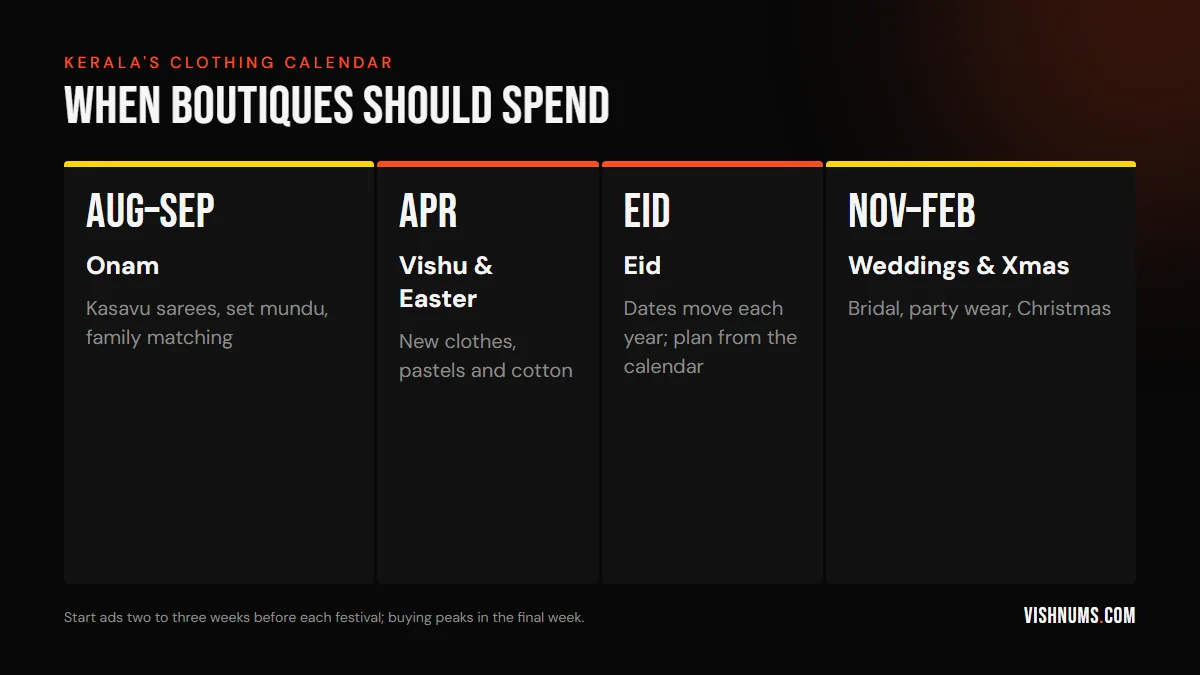
Each season has its own products, buyers and timing.
Onam
Kerala's biggest clothing season. Kasavu sarees, set mundu, Kerala-style dhotis, matching family outfits and kids' pattu pavada. Offices hold Onam celebrations, so working women buy sarees for those too, often a week or two before the festival itself. Many boutiques now sell "family combo" sets.
Vishu and Easter
Both usually fall in April. Families buy new clothes, often lighter cottons and pastels for the summer heat.
Eid
Eid dates move each year with the lunar calendar, so plan from the current year's dates, not last year's. Modest wear, embellished kurtis, abayas and kids' outfits sell well.
Christmas and wedding season
From November to February, party wear, wedding guest outfits, bridal and bridesmaid wear and Christmas outfits dominate. Bridal boutiques see enquiries months in advance.
Smaller moments
School reopening, college fests, office events and Navratri (for some communities) bring smaller spikes. Keep a calendar and plan a few posts and ads for each.
The rule of thumb: start ads two to three weeks before each festival, and put the largest share of budget into the last ten days, when buying peaks. Keep a small always-on campaign for new arrivals in between, so you don't restart from zero every season.
Store visits and online orders need different campaigns
Most Kerala boutiques sell both in the shop and online. The two need different setups.
Store traffic campaigns
- Location: a reasonable driving radius around your shop. People won't cross a city for a kurti, but they will for a bridal outfit.
- Creative: the shop itself, the racks, staff helping customers, the festival collection in the store.
- Call to action: directions, call, or a WhatsApp chat to check stock before visiting.
- Measurement: ask customers how they found you, and use ad-specific offers ("Show this Reel for a free gift").
Many shoppers in Kerala still want to touch the fabric and see the colour in person, especially for expensive sarees.
Online sales campaigns
- Location: all of India, or specific cities with many Malayalis.
- Creative: products worn, close-ups, prices, sizes.
- Setup: a website with a catalogue, or Instagram Shopping, with the Meta pixel and Conversions API.
- Retargeting: catalogue ads to people who viewed products.
If you run a Shopify store, catalogue ads for Shopify stores explain how to set up the product feed and retargeting.
Boost or Ads Manager?
Many boutiques only use the Boost button. Boosting is fine to give a popular post more reach, but it offers fewer goals, less control over placements and limited targeting. For festival sales, use Ads Manager with a sales or messages objective so Meta looks for buyers, not just people who like posts. Our guide to boost post vs Ads Manager for small businesses explains the differences in detail.
Creatives that sell clothes
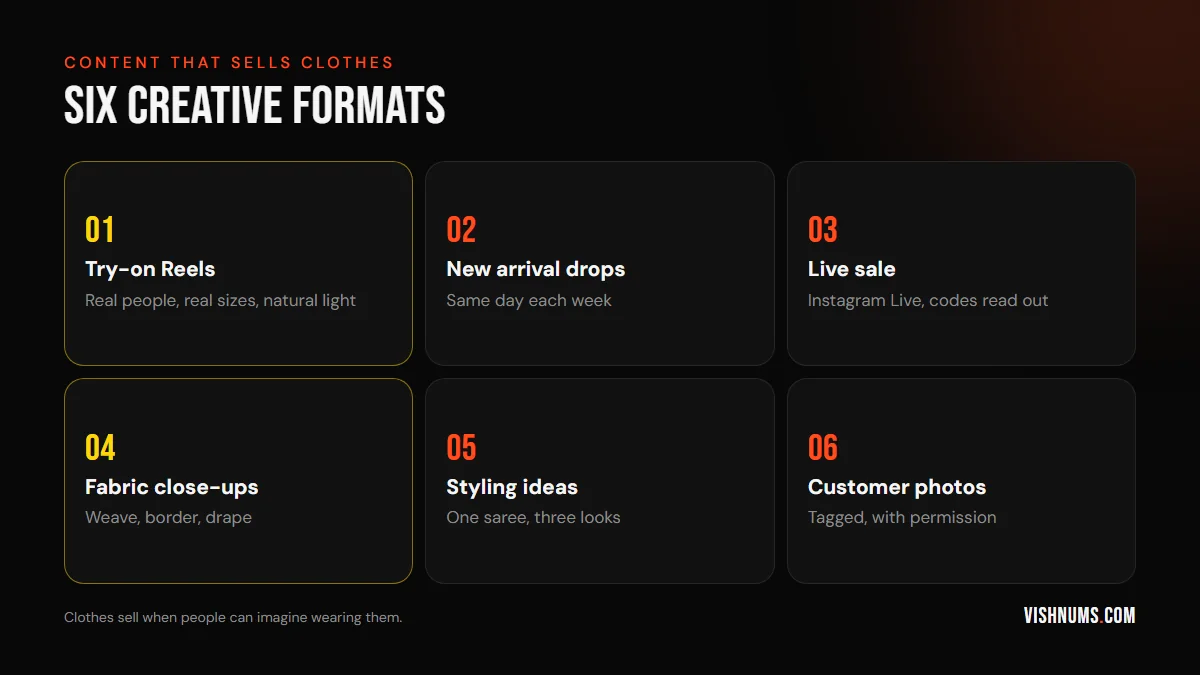
Flat product photos on a hanger rarely sell a saree. People need to imagine wearing it.
Try-on Reels
Staff or real customers (with permission) wearing the piece, turning, walking, in natural light. Include a range of body types and ages, especially for kurtis and dresses. Say the size the person is wearing.
Fabric close-ups
The weave, border, zari work, embroidery and drape, filmed slowly. On a phone screen, close-ups help people judge quality.
Styling ideas
"One saree, three looks": different blouses, jewellery and draping styles. These get saved and shared, and they help people see value in a piece.
New arrival drops
Post new stock on the same day each week, so followers know when to check. Use countdown stickers in Stories before a big drop.
Customer photos
Customers wearing your outfits at weddings, Onam celebrations or office events, tagged and shared with permission. This is the strongest proof you have.
Price and details on screen
Put the price, fabric and sizes in the caption or on screen. Hidden prices create "DM for price" comments, and most of those people never buy.
Product photography on a budget
You don't need a studio to shoot clothes that sell. You need consistency and daylight.
- Shoot near a large window or outdoors in shade, between mid-morning and late afternoon. Avoid direct harsh sun and yellow indoor tube lights.
- Use a plain wall or a simple backdrop that doesn't compete with the fabric.
- Keep the same setup every week, so your feed looks consistent and shooting gets faster.
- Film on a recent phone at its highest quality, holding it steady or on a small tripod.
- Capture four shots per piece: full look, close-up of the fabric, the border or detail work, and a short movement clip.
- Don't over-edit. Colour accuracy matters more than a perfect look. A customer who receives a different shade than she saw is likely to return it and won't trust your photos again.
Batch your shooting: one afternoon a week for all new arrivals. That gives you enough content for posts, Stories, Reels and ads.
Set up your profile and catalogue
Shoppers who like an ad nearly always check the boutique's profile next. Set it up so buying feels easy:
- Bio: what you sell, where you are, delivery areas, and how to order ("Order on WhatsApp · Delivery across Kerala").
- Highlights: one each for new arrivals, sarees, kurtis, bridal, customer photos, prices and delivery, and how to order.
- Instagram Shopping or a WhatsApp catalogue, with prices, so people can browse without asking.
- Pinned posts: your best-selling collection, a store tour, and customer photos.
A profile that answers questions before they're asked turns more ad clicks into orders.
Bridal boutiques: a different playbook
Bridal wear is a different business from everyday ethnic wear. A bride's outfit is expensive, planned months ahead, chosen with family, and often customised.
- Start early: brides begin looking soon after the engagement. Advertise to engaged women and retarget people who watch your bridal Reels for several months.
- Show complete looks: saree or lehenga with blouse, jewellery and hairstyle, ideally on real brides (with permission).
- Explain customisation: fittings, timelines and how many trials are included.
- Offer appointments, not walk-ins, so the bride gets your full attention.
- Work with makeup artists and photographers who meet brides early. Our guide to Meta ads for salons and bridal makeup artists explains how brides choose.
Many brides also buy outfits for every function: engagement, haldi, mehendi, wedding and reception. Packages across functions raise order value and keep the bride with one boutique.
Offers without a discount war
Constant discounts train customers to wait for sales and eat into margins. Better ways to create urgency:
- Limited stock: "Only four pieces in this print." True scarcity is powerful, and common in handloom.
- Early-bird festival previews for past customers.
- Free gifts such as matching bangles or a stitching service, instead of cutting prices.
- Combo offers for family sets.
- Free delivery above a certain order value.
If you do run a sale, keep it short and clearly dated. A boutique that's always on sale stops feeling special.
Sample captions and ad text
Onam collection
Primary text: "Our Onam kasavu collection is here: handloom-style sarees from ₹[price], set mundu from ₹[price], and matching family sets. Visit our [town] store or order on WhatsApp. Delivery across Kerala in [days] days."
Headline: "Onam kasavu sarees and family sets"
Wedding guest wear
Primary text: "Wedding season outfits for every function: kurtis, shararas and party sarees from ₹[price]. Sizes S to XXL. See them worn in our Reels, then message us your size."
Headline: "Wedding guest outfits, sizes S–XXL"
NRI customers
Primary text: "Onam at home this year? Order your family's kasavu sets from [Boutique] before you fly, and we'll keep them ready for pickup or deliver them to your home in Kerala."
Headline: "Order Onam outfits before you fly home"
Stop losing sales in the DMs
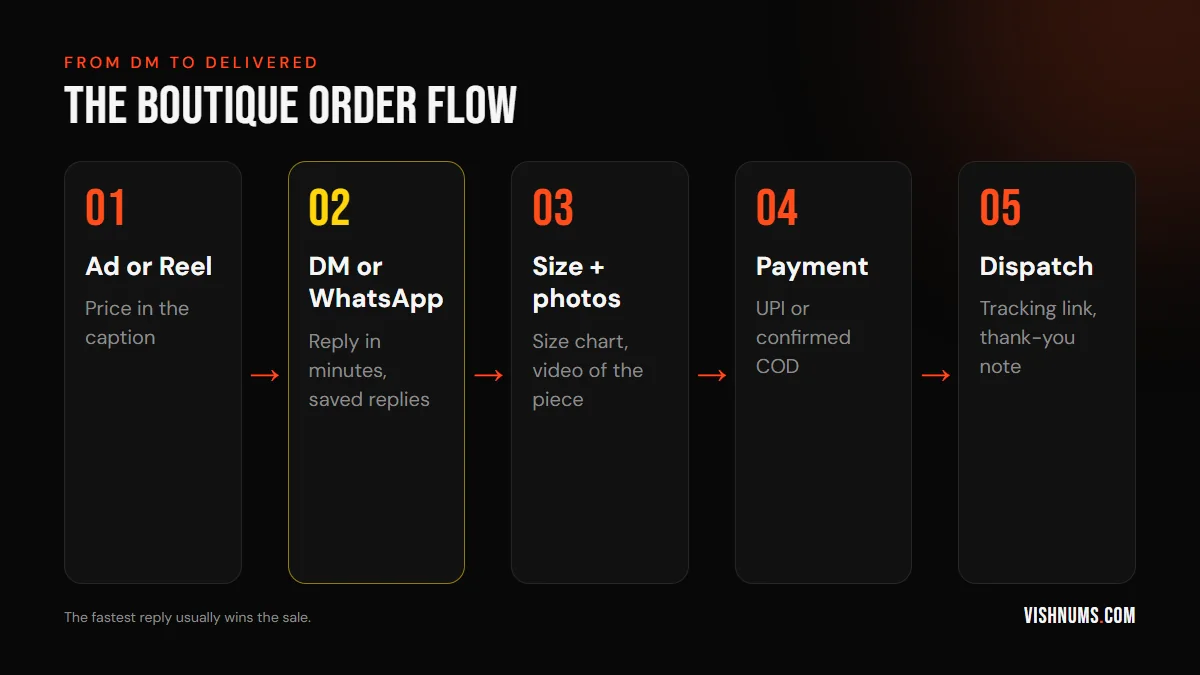
The biggest leak in boutique marketing is the slow or missing reply. A customer who comments "price?" and hears back six hours later has often bought elsewhere.
Fix it with simple systems:
- Saved replies in Instagram and WhatsApp Business for common questions: price, sizes, delivery time, return policy, payment options.
- A size chart image ready to send, with measurements for each size.
- Short video replies: a quick clip of the actual piece in daylight answers colour questions better than words.
- Clear hours: if you can't reply at night, set an auto-reply with your price list link and the time you'll reply.
- One person responsible for messages during festival campaigns.
Track which ads lead to orders, not just messages. How to track WhatsApp leads from Facebook ads explains a simple tagging method that works for boutiques.
Live selling
Instagram Live sales work well for boutiques with an engaged following. A typical format:
- 01Announce the live in Stories a day before and an hour before.
- 02Show each piece on a person, with price, fabric and sizes.
- 03Ask viewers to comment the item number and their size to reserve it.
- 04Confirm reservations on WhatsApp after the live with a payment link.
- 05Save the live and post highlights as Reels afterwards.
Lives build a sense of occasion, and the comments become social proof. Keep it organised, though; a chaotic live with unanswered comments damages trust.
Reach Malayalis outside Kerala
Sarees and festival clothing are often bought by Malayalis in Bengaluru, Chennai, Mumbai, Delhi and the Gulf, for festivals at home or celebrations where they live. A separate campaign before Onam, Vishu and Christmas can reach them:
- Locations: Indian metros with large Malayali populations, plus Gulf countries if you can deliver to Kerala homes or ship internationally.
- Message: authentic Kerala styles, delivery times, and the option to have outfits delivered to family in Kerala.
- Language: Malayalam or a mix, which signals you're the real thing.
For Gulf targeting, see how to target NRIs in the Gulf with Meta ads. For language choices, see regional-language ads.
COD, returns and exchanges
Clothing has high return rates because of size and colour expectations. For COD orders outside Kerala, returned parcels cost you shipping both ways and can damage the garment.
- Confirm every COD order on WhatsApp before dispatch, with a photo of the exact item.
- Offer a small prepaid discount.
- Publish a clear exchange policy for size issues, and make it easy, so customers exchange instead of refusing parcels.
- Show accurate colours: shoot in daylight and avoid heavy filters.
Our guide to reducing RTO on COD orders from Meta ads has a full checklist.
Measuring what works
Track a few numbers per campaign and per festival:
- Messages and online orders
- Orders confirmed and delivered (not returned)
- Average order value
- In-store sales during the campaign period, compared with the same period last year
- Which products sold, so you can restock and plan next season's ads
After each festival, write a short note: what sold, which creatives worked, what ran out, what didn't move. Next year's Onam plan starts from this note, and it will save you from repeating the same stock and budget mistakes.
Sizing an Onam budget
Treat these numbers as a sketch of the calculation rather than a forecast for your boutique.
A boutique spends ₹20,000 on Onam ads over three weeks. The campaign brings 400 messages and 60 online orders with an average value of ₹2,500, worth ₹1.5 lakh. Store sales during the period rise compared with last year, and staff log 35 customers who mention seeing the ads.
If the boutique's margin on clothing is healthy, ₹20,000 for ₹1.5 lakh of online sales plus extra store sales is a good return. But notice the messages: 400 conversations for 60 orders. If faster replies turned even 20 more of those into orders, the return would rise sharply without extra ad spend.
What not to do
- Starting festival ads too late, when everyone else is advertising too.
- "DM for price" instead of showing prices.
- Flat lay photos only, with no try-on content.
- Slow DM replies during the busiest weeks.
- Only boosting posts instead of using sales or messages campaigns.
- Heavy filters that make colours look different from the real piece.
- Ignoring COD confirmation, then losing money on returned parcels.
- Forgetting customers after the sale, when a simple WhatsApp message before the next festival would bring them back.
Home-based sellers: building trust from scratch
Many successful Kerala boutiques started as home-based Instagram sellers, and many still are. Without a physical store, trust is the main hurdle: customers worry about paying in advance to someone they've never met.
- Show your face and your space. A short video introducing yourself and where you source fabrics makes you real.
- Post delivery proof: packed parcels, courier receipts with personal details hidden, and customer unboxing videos (with permission).
- Collect and highlight reviews from the start, even from friends and early customers who paid.
- Offer COD carefully for first orders in Kerala, with confirmation, to reduce the risk customers feel.
- Register your business and get a GST registration when your turnover requires it, then mention it. It signals that you're a serious business.
Ads amplify trust that already exists on your profile. Build it first, then spend.
Bring customers back for every festival
Your past customers are your best audience. With their consent, save their WhatsApp numbers and send a short message before each festival with your new collection. A WhatsApp broadcast or a simple catalogue link often brings more orders than a new ad campaign, at a fraction of the cost.
You can also build a custom audience of past customers in Meta (where you have consent) and show them festival previews before anyone else.
A festival campaign checklist
Use this before each big season:
- 01Decide the hero products and stock levels for the festival.
- 02Shoot try-on Reels and close-ups at least three weeks before.
- 03Prepare saved replies, size charts and price lists.
- 04Launch store and online campaigns two to three weeks before the festival.
- 05Run a live sale a week before.
- 06Increase budget in the final ten days.
- 07Message past customers with the collection.
- 08After the festival, record what sold and which ads worked.
Frequently asked questions
When should a boutique start Onam ads?
About two to three weeks before Onam, with the largest budget in the final ten days. Office Onam celebrations often happen earlier, so working customers start shopping sooner.
Should boutiques boost posts or use Ads Manager?
Use Ads Manager for sales and messages campaigns. Keep the Boost button for giving an already-popular post a little more reach.
How do I sell sarees online to NRIs?
Run a separate campaign for Gulf countries and Indian metros before festivals, show the saree worn, state delivery times and costs clearly, and offer delivery to family homes in Kerala.
Should I show prices in Instagram ads?
Yes. Showing prices reduces "DM for price" comments and brings in people who are ready to buy at your price point.
How can I reduce returns on online clothing orders?
Shoot in daylight with accurate colours, provide size charts and video replies, confirm COD orders before dispatch, and offer easy size exchanges.
How much should a boutique spend on festival ads?
Pick an amount you can keep spending every day of the festival run-up, and that your team can handle in messages. Measure orders and store sales, then increase spend next season on what worked. A small budget with fast replies often beats a large budget with slow ones.
Running a boutique and want this festival season to be your best yet? Request a quote.
Ads, a website that converts, or both: get a custom quote.