Meta Ads for Optical Stores in Kerala: Eye Tests, Frames and Lenses That Bring Customers In
How optical stores in Kerala can use Meta ads to fill eye test slots: policy-safe copy, campaigns for kids, screen workers and over-40s, clear lens pricing and annual reminders.

Optical stores in Kerala face a changing market. Large national chains have opened showrooms in every big town, online eyewear brands advertise cheap frames with free home try-ons, and supermarkets sell ready-made reading glasses. Yet local optical shops still serve a huge share of customers, because eye care is personal: people want a trusted optometrist, a proper eye test, frames they can try on, and someone to fix the nose pad when it breaks.
The challenge is reaching new customers and bringing them into the store. Many optical shops only advertise through newspaper inserts, local cable TV or the occasional boosted post. Meta ads can do much more, if you get the messaging right.
What follows is a playbook for optical stores and eyewear shops in Kerala that want Meta ads to fill the eye test chair. It covers the different customer groups, policy-safe copy, eye test campaigns, frames and lenses, competing with online brands, children's eyewear, seniors and progressive lenses, NRIs, the in-store experience, reminders and repeat customers, Google search, and measurement. You'll find ad copy for each customer group, content ideas you can film in your store, and a 90-day plan.
Quick answer
- Lead with the eye test: it's the reason most people visit and the start of most sales.
- Describe your services, never the viewer's eyesight, to stay within Meta's policies.
- Run separate campaigns for kids, screen workers, over-40s and style buyers.
- Compete with online brands on expertise, fitting, aftercare and same-day service.
- Explain lens options and prices clearly; confusion loses sales.
- Send reminders for annual eye tests and replacement glasses.
Know who walks into your store
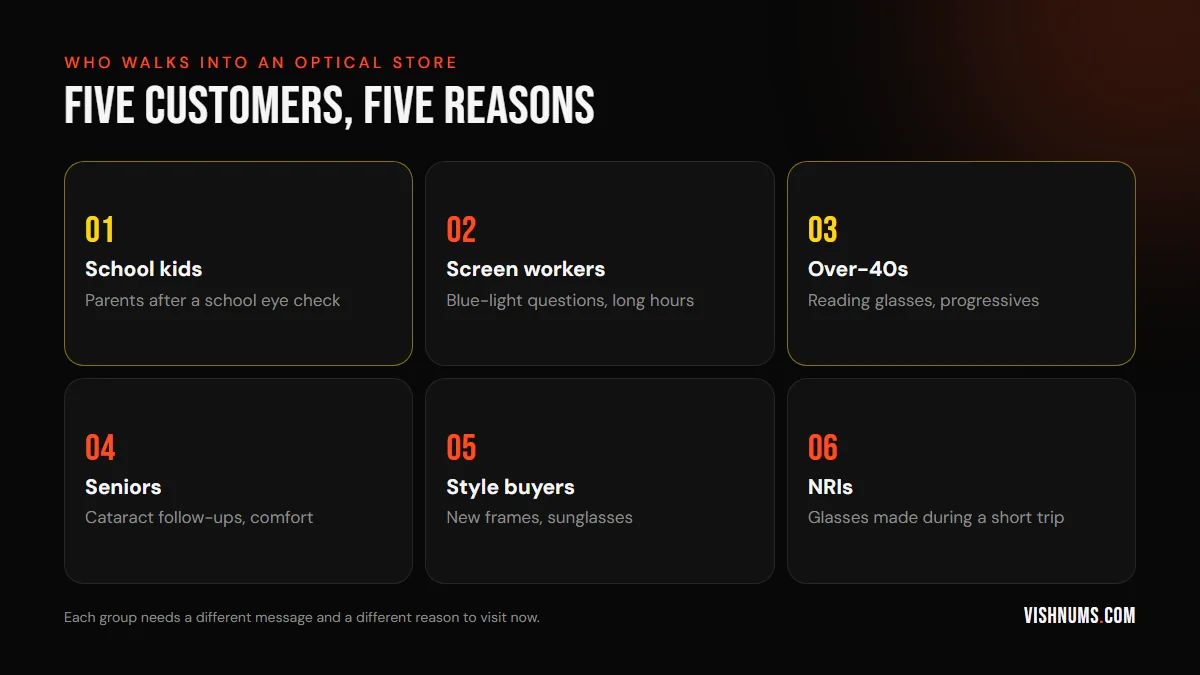
School children
Parents bring children after a school eye check, a teacher's note, or when the child complains about the board. Parents want reassurance, durable frames and fair prices.
Screen workers
IT professionals, students, office workers and anyone spending long hours on screens. They ask about blue-light lenses, anti-glare coatings and eye strain.
People over 40
Most people start needing reading glasses in their 40s. Many also need progressive lenses, which require accurate measurements and expert fitting.
Seniors
Older customers who need regular eye tests, sometimes after cataract surgery, and value comfort, patience and trust.
Style buyers
People who want new frames, sunglasses or a second pair, often influenced by trends and brands.
NRIs
Many NRIs get glasses made during trips home because of price, familiarity or trust in their local optician. They have limited time and want quick service.
Give your priority groups their own ad sets, with creatives and messages that speak to their situation.
Write eyewear ads Meta will approve
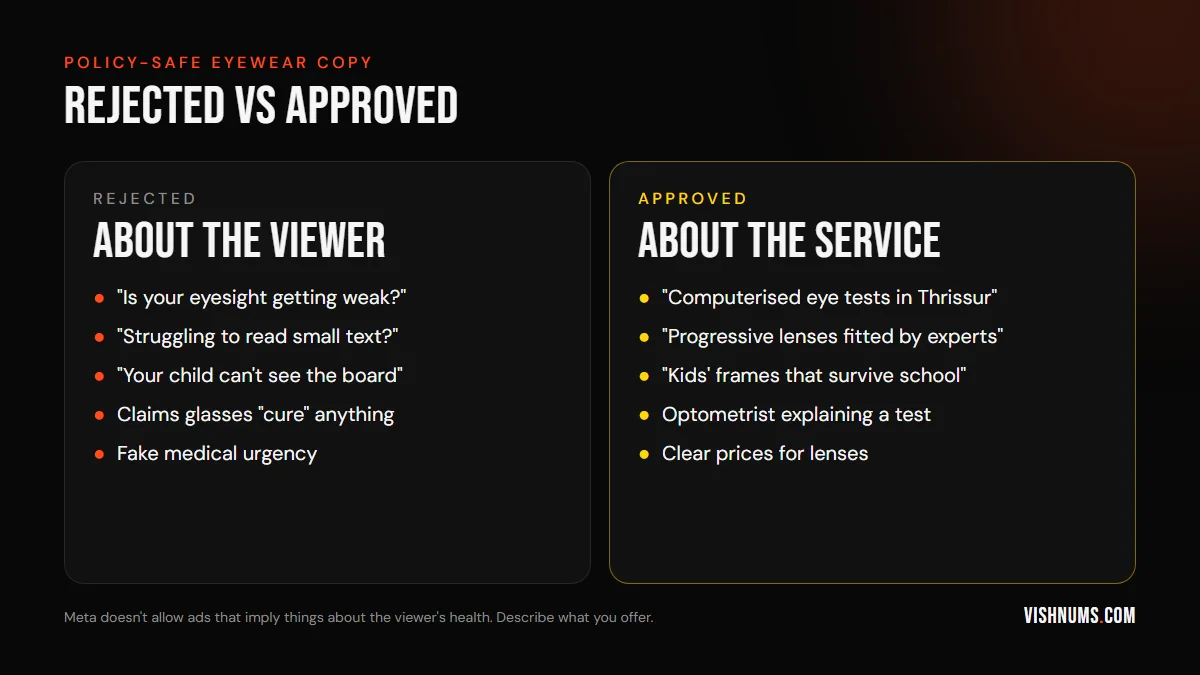
Eyewear ads often get rejected for sounding as if they know the reader's eyesight is failing. Typical offenders:
- "Is your eyesight getting weaker?"
- "Struggling to read your phone?"
- "Can your child see the board clearly?"
Rewrite them to describe your services:
- "Computerised eye tests by qualified optometrists in [town]."
- "Reading glasses and progressive lenses, fitted properly."
- "Kids' eye tests and durable frames for school."
Avoid claims that glasses or lenses "cure" or "improve" eyesight, and don't create false medical urgency. If you work with an ophthalmologist, describe their services accurately and keep medical claims factual.
Lead with the eye test
The eye test is the start of most optical sales. People who come in for a test usually leave with an order, especially if the experience is good. Make the eye test the centre of your advertising:
- Explain what happens: a short video of your optometrist running through the test, the equipment and how long it takes.
- State the price or offer: many stores offer free or low-cost tests; say so clearly.
- Make booking easy: WhatsApp booking with specific time slots.
- Mention qualifications: a qualified optometrist builds trust over a salesperson.
Our guide to Meta ads for dental clinics in Kerala covers a similar "consultation-first" model, if you want more ideas.
Eyewear ad templates
Eye test
Primary text: "Book a computerised eye test at [Store], [town], with our qualified optometrist. It takes about 20 minutes, and we'll explain your results and lens options clearly, with no pressure to buy. Choose a time on WhatsApp."
Headline: "Eye tests by qualified optometrists"
Kids
Primary text: "School eye check sent a note home? Bring your child to [Store] for a gentle eye test, then choose from flexible, durable kids' frames that survive the school bus. Frames from ₹[price]."
Headline: "Kids' eye tests and school frames"
Over-40s
Primary text: "Progressive lenses let you see near, middle and far with one pair. At [Store], we take precise measurements and fit them properly, so they're comfortable from day one. Book a consultation."
Headline: "Progressive lenses, fitted properly"
Frames
Primary text: "New frames for the new year? Try on over [number] styles at [Store], from classic metal frames to bold acetate, with lenses made in [time]. Bring your prescription or book an eye test."
Headline: "Try on new frames in [town]"
Explain lenses clearly
Lenses confuse most customers. Single vision, bifocal, progressive, anti-glare, blue-light filter, photochromic, high-index, polycarbonate: the options and prices vary widely. Confusion leads to two problems: customers who walk out to "think about it", and customers who feel upsold.
Make it simple:
- A clear lens price list by type and coating, displayed in-store and shareable on WhatsApp.
- Short explainer videos on common lens types and coatings, in Malayalam.
- Honest recommendations: explain which options are useful for the customer's needs and which are optional.
- Good-better-best packages for frames plus lenses, so people can choose confidently.
Customers who understand what they're paying for trust you and come back.
Compete with online eyewear brands
Online brands advertise heavily, with low prices and home try-ons. Don't try to beat them on price alone. Advertise what a local store does better:
- A proper eye test by a qualified optometrist, with time to explain.
- Accurate fitting: frame adjustment, pupil distance, fitting height for progressives.
- Same-day or next-day glasses for common prescriptions.
- Aftercare: free adjustments, nose pad replacements, screw tightening, cleaning, help when something breaks.
- Trusted advice from people who know the family.
Some customers buy frames online and bring them for lenses or adjustments. Welcoming them, with fair charges, often turns them into regular customers.
Children's eyewear
Children's eye care is an important and growing part of optical business, as screen time increases. Parents need reassurance:
- Make the eye test child-friendly: patient staff, simple explanations, a few minutes to settle in.
- Offer durable, flexible frames and impact-resistant lenses.
- Provide replacement or breakage plans for children's glasses.
- Send reminders for regular check-ups, as recommended by your optometrist.
Time campaigns for school reopening and after school eye screening programmes in your area.
Seniors and progressive lenses
Older customers value patience, comfort and trust. For progressive lenses especially:
- Explain the adjustment period honestly, so customers aren't surprised.
- Offer a follow-up visit to check comfort and fit.
- Have a clear policy for re-adjustments if lenses aren't comfortable.
- Make the store accessible: seating, good lighting, help with paperwork for any insurance or employer reimbursement.
Many seniors' children live abroad or in other cities and may book or pay for their parents' glasses. Speak to them too, and offer to send them a photo of the new frames once they're ready.
Reach NRIs
NRIs often get glasses made during trips home. Make it easy for them:
- Catch them before the trip: ads in the Gulf ahead of the holidays, inviting a booked eye test for their first days back.
- Promise quick turnaround for common prescriptions.
- Offer to keep their prescription and frame preferences on file for next time.
The targeting setup is in how to target NRIs in the Gulf with Meta ads.
The in-store experience
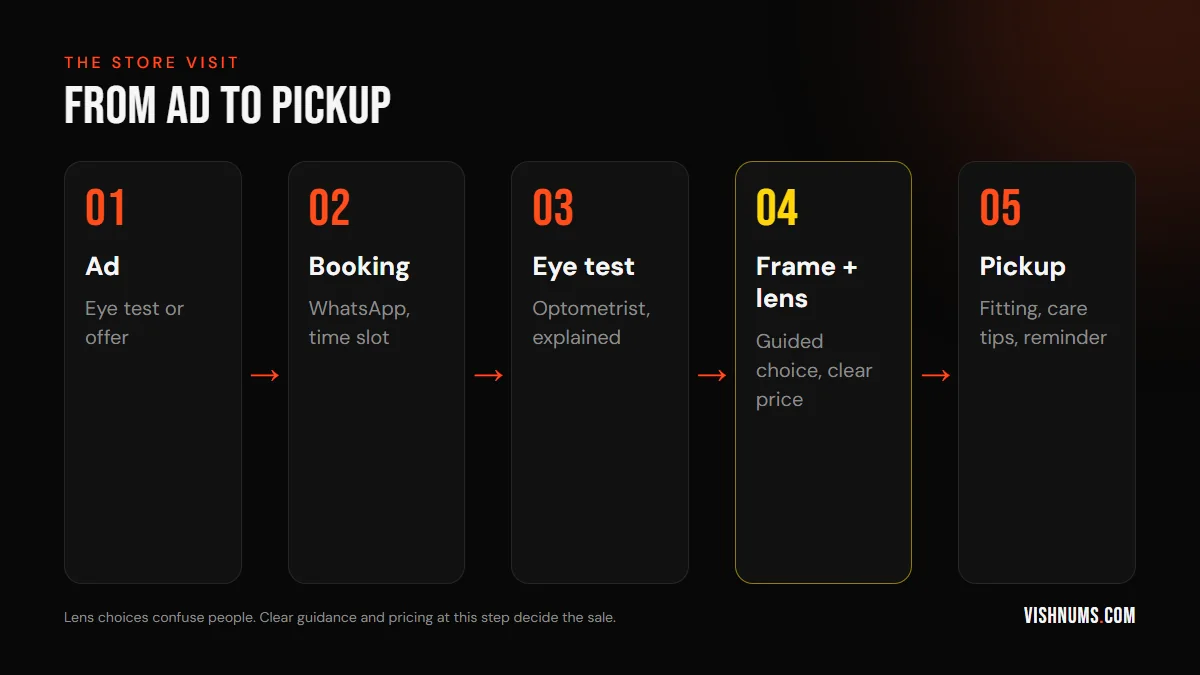
Ads bring people in; the visit decides the sale.
- Welcome customers promptly and offer a seat.
- Explain the eye test results in simple terms.
- Guide frame selection based on face shape, prescription, lifestyle and budget, without pressure.
- Explain lens options and prices clearly before taking the order.
- Give a clear pickup time, and message when the glasses are ready.
- At pickup, fit and adjust the frames, explain care, and mention free adjustments.
Each step either builds trust or erodes it, and customers notice small things: being kept waiting without explanation, a rushed test, or a price that changes at the counter. A good experience turns a single customer into a family's optician.
Reminders and repeat customers
Most people need a new eye test every year or two, and new glasses when their prescription changes or frames wear out. With consent, keep simple records and send reminders:
- Annual eye test reminders, timed from the last visit.
- Children's check-up reminders, as advised by your optometrist.
- Contact lens reorder reminders, if you sell them.
- Festival offers for existing customers before the public.
A family that gets every pair of glasses from you for a decade is the real prize. Keep messages occasional and useful, include an easy way to opt out, and never share customers' prescription details with anyone else.
Contact lenses and sunglasses
These products can add steady revenue:
- Contact lenses: advertise fittings with your optometrist, trial lenses, and reorder convenience. Be careful with claims, and don't promote coloured contact lenses as fashion items without proper fitting advice.
- Sunglasses: Kerala's bright sun makes UV protection important. Advertise before summer and holiday seasons, with prescription sunglasses as an option.
Content ideas for an optical store
Regular, helpful content builds trust and gives you material for ads. Ideas you can film in the store:
- 01What happens in an eye test, step by step, with your optometrist.
- 02Single vision, bifocal or progressive? A simple explainer.
- 03Anti-glare and blue-light lenses: what they do, and what they don't.
- 04How to choose frames for your face shape, with staff trying different styles.
- 05How to clean your glasses properly, and what damages coatings.
- 06Kids' frames that survive: a bend test on a flexible frame.
- 07Same-day glasses: behind the scenes in your fitting lab.
- 08New arrivals: a quick try-on of the latest frames.
- 09Sunglasses and UV protection for Kerala's bright summers.
- 10Customer stories: a senior customer who finally found comfortable progressives, with permission.
Keep the tone helpful rather than salesy, and keep health information general. Encourage people to get a proper eye test rather than diagnosing themselves.
Corporate and institutional customers
Companies, schools and institutions can bring large orders and steady referrals:
- Corporate eye check-up camps for office staff, especially screen workers, often with discounts on glasses for employees.
- School eye screening programmes in partnership with schools, with clear follow-up for children who need full tests.
- Residential association camps for seniors.
Approach these through direct outreach, and use a small local ad budget to promote public camps a week in advance. Always explain results responsibly and refer people to an eye doctor when the test suggests a medical issue.
Offers that don't cheapen your store
Optical retail is full of "buy one get one" and "flat 50% off" offers. They bring footfall, but they can train customers to wait for sales and make your prices look inflated. Better options:
- Free eye tests with a clear explanation of what's included.
- Frame and lens packages at fixed, honest prices.
- Free second pair of reading glasses with progressive lenses.
- Student and senior citizen discounts with ID.
- Free aftercare for the life of the frame.
If you run a sale, keep it short, clearly dated and genuine.
Handling complaints and remakes
Eyewear complaints are common: blurry vision with new glasses, progressives that feel strange, frames that slip. How you handle them decides whether the customer returns.
- Listen first, and check the prescription and fitting.
- Explain any adjustment period honestly, especially for progressives.
- Remake lenses where there's a genuine error, without argument.
- Follow up a week later to check that everything is comfortable.
A clear, fair remake policy, explained at the time of purchase, reduces stress for both sides and builds lasting trust.
Getting found on Google
Many people search "optical shop near me" or "eye test [town]." A strong Google Business Profile brings steady walk-ins:
- Correct category and opening hours.
- Photos of the store, the frame display, the eye test room and your team.
- Services listed: eye tests, contact lenses, kids' eyewear, repairs.
- Reviews, each answered.
Our guide to Google Business Profile for resorts and homestays covers profile basics that carry over directly.
Targeting and budget basics
Optical customers usually shop close to home or work. Keep targeting practical:
- Radius targeting around your store, adjusted for traffic and nearby towns.
- Age ranges by campaign: parents in their 30s and 40s for kids' eyewear, people over 40 for reading and progressive lenses, broader ages for frames and sunglasses.
- Separate ad sets per branch if you have more than one store, each with its own address and phone number.
- A steady monthly budget rather than short bursts, because eye test demand is spread throughout the year, with extra spend before school reopening and festivals.
Avoid splitting a small budget across too many ad sets. If Meta shows "Learning limited", combine ad sets; Meta ads learning limited on a small budget explains why.
Set up WhatsApp booking
Click-to-WhatsApp ads suit optical stores because people want to ask about test timings, frame prices and how long glasses will take. Prepare saved replies for:
- Eye test timings and price.
- Frame price ranges and brands.
- Lens price list.
- Turnaround times.
- Location, parking and opening hours.
End every reply with a specific time slot offer. "Would 11 am or 5 pm tomorrow suit you?" turns a question into a booking. For more on the format, see Click-to-WhatsApp vs lead form ads.
Tracking from test to order
Track by campaign:
- Eye test bookings
- Tests completed
- Orders placed after tests
- Average order value
- Repeat customers within two years
Ask every new customer how they heard about you, and tag WhatsApp chats from ads. How to track WhatsApp leads from Facebook ads explains a simple method.
From eye tests to orders, in numbers
These figures are for illustration; your store's averages will be different.
An optical store spends ₹15,000 a month on an eye test campaign. It brings 120 WhatsApp enquiries and 60 eye test bookings, of which 50 attend. Thirty-five customers order glasses, with an average order of ₹4,000, for ₹1.4 lakh in sales.
If each customer returns every two years, brings family members, and buys sunglasses or a second pair, the long-term value is much higher than the first order. Measuring the test-to-order rate also shows where to improve: if many people take the test but don't order, look at lens explanations and pricing before changing the ads.
Common mistakes optical stores make
- Ads that ask about the viewer's eyesight, which get rejected.
- Price-only ads competing with online brands.
- Confusing lens pricing that drives customers away.
- Pushy upselling that damages trust.
- No reminders for annual tests.
- Slow replies to WhatsApp enquiries.
- Ignoring children's eyewear, a growing need.
- Outdated Google listings.
Three months to a steadier store
Days 1 to 30: rewrite ad copy to describe services, launch an eye test campaign with WhatsApp booking, and create a clear lens price list.
Days 31 to 60: add separate campaigns for kids or over-40s, film optometrist explainer videos, and start collecting customer details for reminders.
Days 61 to 90: launch reminder messages for past customers, update your Google Business Profile, and measure test-to-order rates by campaign.
Frequently asked questions
How can an optical store get more customers?
Advertise eye tests by qualified optometrists, run separate campaigns for kids, screen workers and over-40s, make booking easy on WhatsApp, explain lenses clearly, and send reminders to past customers.
Why are my eyewear ads getting rejected by Meta?
Usually because the copy asks about the viewer's eyesight or implies a health condition. Describe your services, such as eye tests and lenses, instead.
How can a local optician compete with online eyewear brands?
Advertise proper eye tests, accurate fitting, quick turnaround, aftercare and trusted advice, which online brands can't offer in the same way.
When should optical stores advertise kids' eyewear?
Around school reopening and after school eye screening programmes, with child-friendly eye tests and durable frames.
Should optical stores show prices in ads?
Showing frame starting prices and clear lens prices helps customers decide and builds trust. Hidden prices make people worry about being upsold.
Do free eye test offers work?
Often, yes, because the eye test is the natural start of a purchase. Make sure the test is thorough and explained well, with no pressure to buy; customers who feel respected are more likely to order.
How do I handle complaints about new glasses?
Listen, check the prescription and fitting, explain any normal adjustment period, and remake lenses without argument where there's a genuine error. A fair remake policy builds trust.
Running an optical store and want more eye test bookings? Request a quote.
Ads, a website that converts, or both: get a custom quote.