How to Sell Ayurvedic Products Online With Meta Ads: Claims, Compliance and Creatives
A complete guide for Kerala Ayurveda brands selling hair oils, skin care and wellness products online: which claims Indian law and Meta policy forbid, how Rule 170 changed, plus creatives, offers, margins and scaling.

Kerala is home to hundreds of small Ayurveda brands. Family firms that have made hair oils for generations, young founders selling kumkumadi face oils and herbal powders, vaidyasalas with a loyal local following that want to sell across India. Many now run Shopify stores and Meta ads, and many hit the same walls: ads rejected for health claims, accounts restricted after repeated violations, margins eaten by shipping and returns, or a legal notice over an overenthusiastic claim.
This guide is for Ayurveda brands that want to sell online properly. It covers the legal and policy rules in plain language, what you can and can't say, creative ideas that work, how to structure campaigns, the margin maths most small brands skip, how to work with influencers without risking your brand, how to build repeat purchases, and how to grow beyond Kerala. Each section ends with something you can act on this week.
This guide isn't legal advice. Rules change, and the line between a cosmetic and an Ayurvedic medicine matters, so check your product claims with a regulatory consultant before a big campaign.
The essentials
- Never claim to cure, treat or prevent diseases, and especially not those listed under the Drugs and Magic Remedies Act.
- Rule 170's pre-approval requirement now stands omitted, but the ban on misleading claims remains.
- Meta's policies reject health claims and imagery that imply things about the viewer's body.
- Sell authenticity: the making process, ingredients, the formulator, how to use the product, real reviews.
- Know your break-even ROAS before scaling; small-ticket Ayurveda products have thin margins after GST, shipping and returns.
- Use bundles and multi-month packs to raise order value.
The three sets of rules
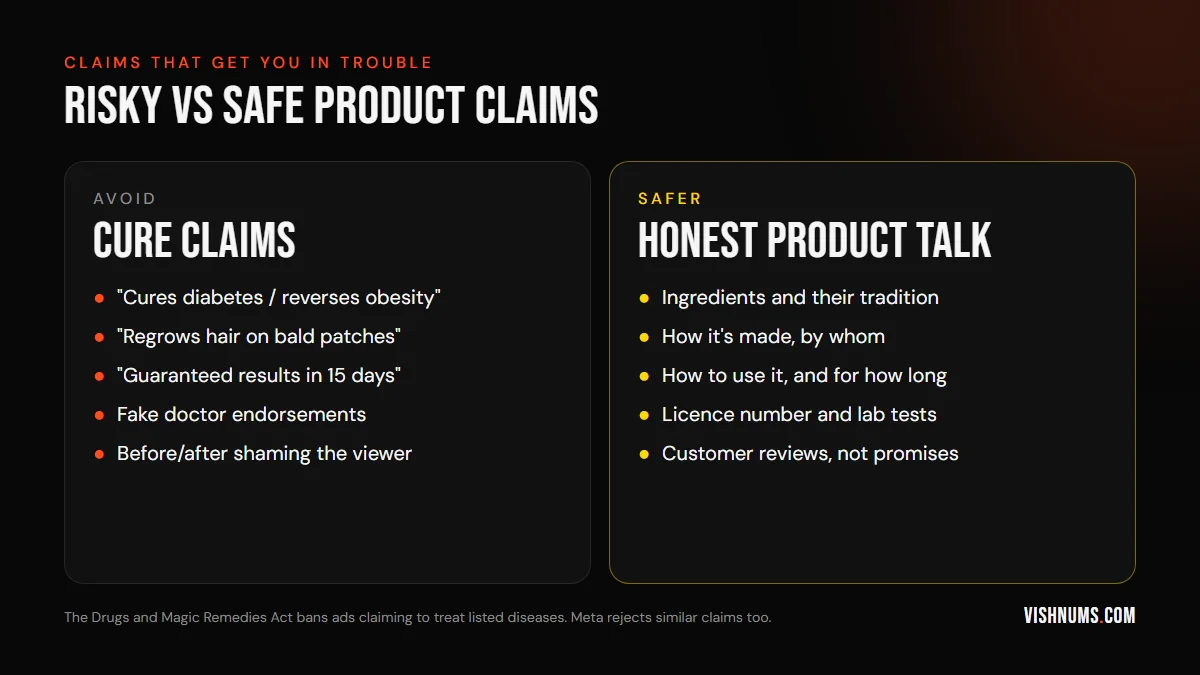
The Drugs and Magic Remedies (Objectionable Advertisements) Act, 1954
This law prohibits advertisements that claim a product can diagnose, cure, mitigate, treat or prevent a list of diseases and conditions set out in its schedule. The list includes conditions such as diabetes and obesity, among many others. It applies to every kind of product, including Ayurvedic medicines. It also bans ads that give a false impression about the true nature of a product or make false claims about it.
In practice: an ad saying your herbal powder "controls sugar" or "melts belly fat" is the kind of claim this law targets.
Rule 170 of the Drugs and Cosmetics Rules
Rule 170 was added in 2018. It required ads for Ayurvedic, Siddha and Unani drugs to be approved by the state licensing authority before they ran. In July 2024, the AYUSH Ministry issued a notification omitting it. In August 2024, the Supreme Court stayed that omission, keeping the rule alive. Then, in August 2025, the Supreme Court lifted its stay and closed the case, so Rule 170 now stands omitted, with liberty for anyone to challenge the deletion in a High Court.
What it means for you: the pre-approval step isn't currently required. The Magic Remedies Act, consumer protection law and advertising codes still apply. Watch for any High Court developments, and check the current position before you rely on it.
Meta's advertising standards
Separately from Indian law, Meta reviews every ad. Its policies reject:
- Unrealistic or misleading health claims.
- Copy that hints the reader has a health or body problem ("Suffering from hair fall?").
- Before-and-after comparisons that shame the "before" or promise unrealistic change.
- Certain health products entirely, depending on the category.
Repeated rejections can restrict your ad account. Recovering from that takes time; see how to appeal a disabled Meta ad account if it happens.
Cosmetic or Ayurvedic medicine?
Many Kerala products sit on a line. A hair oil can be sold as a cosmetic or licensed as an Ayurvedic proprietary medicine. A face oil can be a cosmetic or a classical Ayurvedic formulation. The licence decides what you can claim and what the label must say.
- Cosmetics can talk about cleansing, nourishing, conditioning, appearance and fragrance, but not about treating any condition.
- Ayurvedic medicines carry a drug licence number from the state licensing authority, must follow labelling rules, and can describe their traditional uses within the limits of the law. They still can't make the prohibited claims above.
Be consistent: your ads, website, packaging and marketplace listings should describe the product in the same way, matching its licence. Inconsistency is a common reason regulators and platforms flag brands.
What to say instead
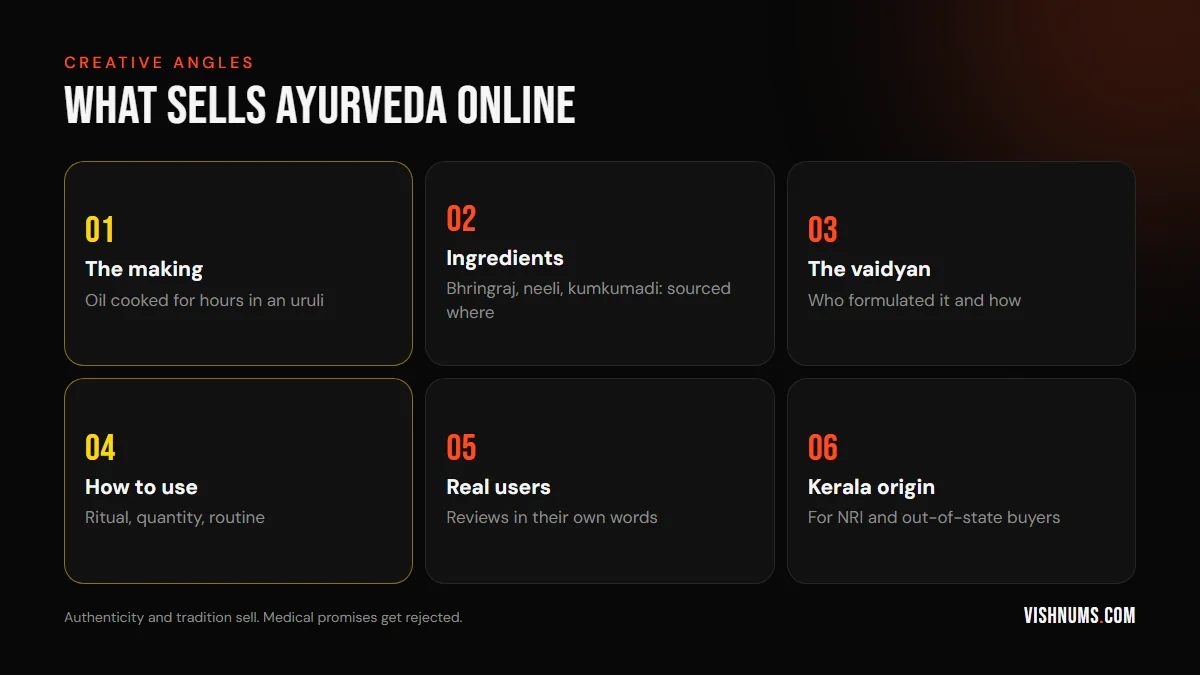
Ayurveda's real strength online is authenticity. Customers buy from brands they trust to make the product the traditional way. That gives you plenty to say without making medical claims.
The making
A Reel showing oil slowly cooked in an uruli for hours, herbs being ground, the kitchen or production unit. This is the single best-performing creative for many traditional brands, because it proves the product isn't a factory imitation.
The ingredients
Name the herbs, explain where they come from, and show them. Bhringraj, neeli, amla, kumkumadi, and so on. People researching Ayurveda often know the names and look for them.
The formulator
Who created the recipe, their training, how long the family has made it. A real vaidyan or a third-generation maker on camera builds more trust than a model.
How to use it
A ritual: how much oil, how to massage it in, how long to leave it, how often. Usage videos reduce disappointment and returns, because people who use a product correctly are more likely to be happy.
Real customers
Reviews in their own words: the scent, the texture, how it fits into their routine. Don't edit them into cure claims, and don't use customer testimonials that make claims you couldn't make yourself.
Proof of quality
Your licence number, lab test reports, GMP certification where you have it, and clear ingredient lists.
Ad copy examples you can adapt
For a traditional hair oil
Primary text: "Made the way our family has made it since [year]: [herbs] slowly cooked in coconut oil for [hours] hours in an uruli. No mineral oil, no artificial fragrance. Massage into the scalp, leave for an hour, wash with a mild cleanser. Made in [town], Kerala."
Headline: "Traditionally made Kerala hair oil"
For a kumkumadi face oil
Primary text: "Kumkumadi tailam, prepared to a classical recipe with saffron and [number] herbs. Three to four drops at night on clean skin. See how we make each batch, and what our customers say about using it."
Headline: "Classical kumkumadi tailam from Kerala"
For a gift or starter kit
Primary text: "New to Kerala Ayurveda? Our starter kit has our hair oil, face oil and herbal bath powder in travel sizes, with a simple guide on how to use each one."
Headline: "Try Kerala Ayurveda in one kit"
Notice what's missing: no promises about curing hair fall, clearing acne, or treating anything. The copy sells the product's making and use, which is enough for people who already value Ayurveda.
Campaign structure for small brands
Most small Ayurveda brands do best with a simple structure:
- One sales campaign with broad targeting in India, three to six creatives, and a budget you can sustain for at least two weeks. Advantage+ sales campaigns can work well here; Advantage+ for small D2C brands explains the setup.
- A catalogue connected to your Shopify store for dynamic retargeting of people who viewed products. See catalogue ads for Shopify stores.
- A small testing budget for new creatives, so you're always finding the next winner.
Avoid splitting a small budget across many campaigns and interests. Meta needs enough conversions in one place to learn; if you see "Learning limited", read Meta ads learning limited on a small budget.
Know your margins before you scale
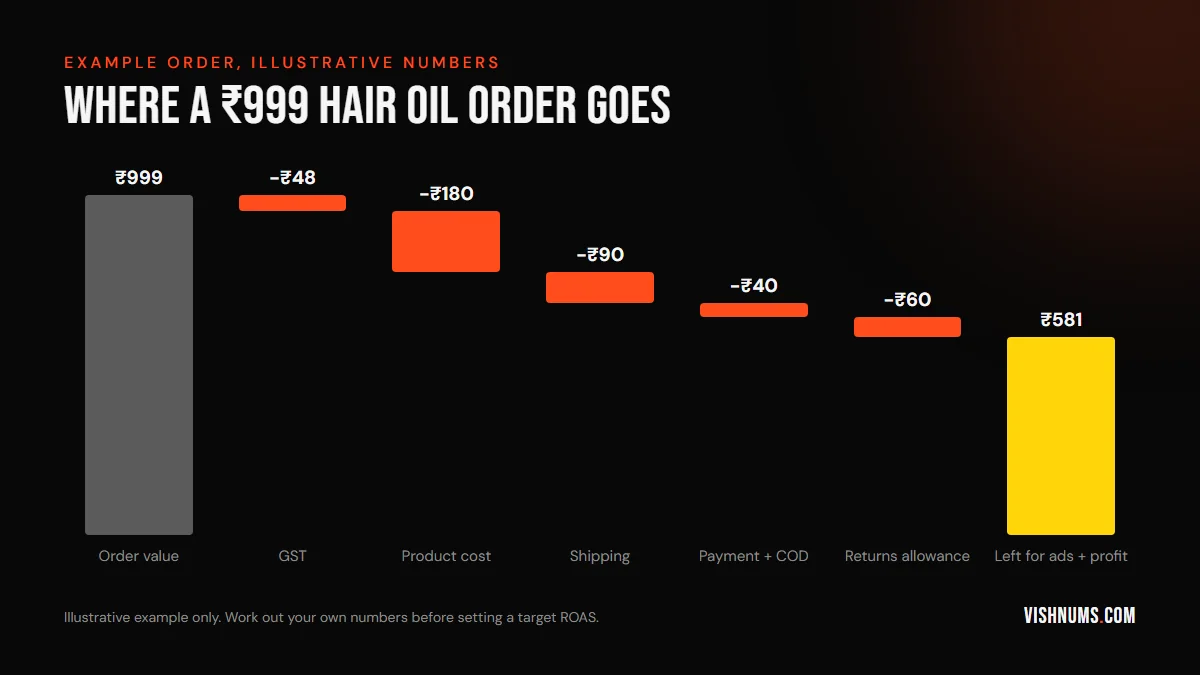
Ayurveda products are often priced between a few hundred rupees and a couple of thousand. After GST, product cost, packaging, shipping, payment gateway fees, COD charges and returns, there's less left for advertising than most founders expect.
Run the calculation for your bestseller:
- 01Start with the average order value, including shipping charged.
- 02Subtract GST. Rates for many personal care and Ayurvedic products were cut in the September 2025 GST revision, so confirm the current rate for each product with your accountant.
- 03Subtract product and packaging cost.
- 04Subtract shipping, payment gateway fees and COD charges.
- 05Subtract an allowance for returned and undelivered orders.
- 06What's left is the most you can spend on ads per order before losing money.
Divide the order value by that amount and you have your break-even ROAS. If you're left with ₹581 on a ₹999 order, as in the illustrative example above (which assumes 5% GST), your break-even ROAS is about 1.7. Anything below that loses money on the first order. The full method is in break-even ROAS for Indian D2C brands.
Raise order value
Low order values are the biggest constraint for Ayurveda brands. Ways to raise them:
- Bundles: hair oil plus herbal shampoo powder; face oil plus face pack.
- Multi-month packs: "Two-month pack" priced slightly better than two single bottles, which also suits products people use regularly.
- Free shipping thresholds set just above your typical order value.
- Starter kits for new customers, priced to cover acquisition costs.
- Subscriptions or reminder messages when a bottle is likely running out.
A higher order value can turn an unprofitable campaign into a profitable one without changing anything else.
Handle COD carefully
Many Indian buyers still prefer cash on delivery, especially for a brand they haven't tried. COD increases conversion rates but brings returns: parcels refused at the door or undelivered. For low-priced products, each returned parcel can wipe out the profit from several successful orders.
- Confirm COD orders on WhatsApp before dispatch.
- Offer a small discount for prepaid payment.
- Restrict COD on pin codes with high return rates.
Our guide to reducing RTO on COD orders from Meta ads has a full checklist.
Repeat customers are the real business
Ayurveda products are used daily and run out. A customer who buys a hair oil once and returns every two months is worth many times the first order. Build for that:
- Collect WhatsApp consent at checkout and send a reminder when the product is likely to run out.
- Include a usage card in the box, with how to use the product and a code for the next order.
- Ask for reviews a few weeks after delivery, when the customer has used the product.
- Retarget past buyers with complementary products.
Track repeat purchase rate by product. A product with strong repeat sales can justify a higher cost to acquire the first customer.
Reach beyond Kerala
"Authentic Kerala Ayurveda" carries weight across India. Test separate campaigns for:
- Indian metros like Bengaluru, Mumbai, Delhi NCR, Chennai and Hyderabad, where many buyers value traditional Kerala products.
- Malayalis outside Kerala, who know the brands from home and miss them.
- NRIs, if your logistics can ship internationally and you have checked the destination country's import rules for herbal products. Many brands start by letting customers in India send gifts to family, which avoids international shipping complexity. For targeting ideas, see how to target NRIs in the Gulf.
Copy for non-Kerala buyers should explain more: what the product is, how it's traditionally used, and why Kerala's tradition matters.
Marketplaces and your own store
Many Ayurveda brands sell on Amazon and other marketplaces as well as their own websites. Each has a role:
- Marketplaces bring buyers who search for products, and they handle much of the logistics. Fees are higher and you own less of the customer relationship.
- Your own store keeps more margin and gives you customer data for repeat marketing. It depends on ads and content to bring traffic.
Make sure claims are consistent across all channels. A marketplace listing that makes a claim your Meta ads couldn't make is still a risk for your brand.
Working with influencers safely
Influencer content works well for Ayurveda, especially creators who already talk about hair care, skin care or traditional living. It also carries a risk: creators often make claims in their own words that you would never put in an ad. If you commissioned the content, regulators and platforms can hold your brand responsible.
Before any collaboration:
- Give a written brief listing what they can say (ingredients, how it's made, how they use it, how it feels) and what they must not say (cures, treats, guaranteed results, before-and-after comparisons).
- Review the content before it goes live, and ask for edits if needed.
- Make sure the paid partnership is disclosed, using the platform's paid partnership label and a clear mention in the caption, as Indian advertising guidelines for influencers require.
- Use the content as ads only after checking it against Meta's policies, since boosted creator content is reviewed like any other ad.
Micro-creators with engaged local audiences often outperform big names for small Ayurveda brands, at a fraction of the cost.
Packaging and the unboxing moment
For a product people will use every day, the first impression continues after the ad. Good packaging reduces returns, earns reviews and makes customers proud to recommend you.
- Leak-proof bottles with a seal; oil leaks are a common reason for complaints and refunds.
- A printed usage guide in English and Malayalam, plus a QR code linking to a how-to video.
- The batch number, licence number and expiry date clearly visible.
- A thank-you card with a code for the next order and a request for a review.
Film your own unboxing and use it as an ad. It answers the question "What will I actually receive?" that many first-time buyers have.
A weekly creative testing routine
Creative fatigue sets in quickly on Meta, especially with small audiences. A simple routine keeps your account fresh without wasting money:
- 01Every week, add two new creatives to your testing campaign, each with a different angle (making process, ingredient story, customer review, usage ritual).
- 02Give each one enough budget to get a fair read, usually a few days.
- 03Move winners into your main sales campaign, and pause the creatives that have clearly stopped working.
- 04Keep a log of every creative, its angle and its results, so you learn which angles work for your brand.
After a few months, the log becomes your most valuable marketing asset: a record of what your customers respond to.
Common mistakes Ayurveda brands make
- Cure claims in ads, listings or influencer content.
- Before-and-after hair or skin photos that break Meta's policies.
- Influencers making claims you can't make. You're responsible for what they say in content you commission.
- Scaling without knowing break-even ROAS.
- Low order values with free shipping on everything.
- Uncontrolled COD, with high return rates on low-value parcels.
- Ignoring repeat customers, who are the most profitable part of the business.
- Inconsistent product descriptions between the label, licence, website and ads.
A 90-day plan for an Ayurveda brand
First month: audit every product claim with a regulatory consultant, rewrite ads and product pages, calculate break-even ROAS for your top products, and launch a simple sales campaign with three or four authenticity-led creatives.
Second month: add bundles or multi-month packs, set up COD confirmation, launch catalogue retargeting, and test a campaign for one Indian metro outside Kerala.
Third month: build your repeat purchase system (reminders, usage cards, reviews), scale the campaigns that beat break-even with healthy margin, and keep testing new making-process and customer-story creatives.
Sources and further reading
The legal position on AYUSH advertising has moved several times. Start with these:
- LiveLaw: Supreme Court vacates stay on AYUSH notification omitting Rule 170 (August 2025)
- India Code for the text of the Drugs and Magic Remedies (Objectionable Advertisements) Act, 1954
- Meta Transparency Center: Health and Wellness ad standards
Frequently asked questions
Can I advertise Ayurvedic medicine on Facebook in India?
Yes, if your ads avoid prohibited disease claims, follow Meta's health policies, and match how the product is licensed. Focus on ingredients, tradition, the making process and how to use the product.
Is Rule 170 still in force?
The AYUSH Ministry omitted it in July 2024, and in August 2025 the Supreme Court lifted its stay on that omission and closed the case. The pre-approval requirement no longer applies, but the Magic Remedies Act's ban on misleading claims still does. Check for later developments before relying on this.
Why are my Ayurveda ads getting rejected by Meta?
Usually because of health claims, copy that refers to the viewer's body or health, or before-and-after images. Rewrite the ad around the product, its ingredients and its use.
What sells Ayurvedic products online best?
Videos of the traditional making process, clear usage instructions, the formulator's story, real customer reviews, and bundles that raise order value.
What ROAS do Ayurveda brands need on Meta ads?
It depends entirely on your margins. Calculate your break-even ROAS from your own order value, GST, product cost, shipping, fees and returns, then aim comfortably above it.
Can influencers say my product cures something?
No. If you commissioned the content, you can be held responsible for the claims in it. Brief creators in writing, review content before it goes live, and make sure paid partnerships are disclosed.
Should I sell on Amazon or my own website?
Many brands do both. Marketplaces bring search traffic and handle logistics; your own store keeps more margin and gives you customer data for repeat sales. Keep claims consistent everywhere.
Selling Ayurveda online and want ads that stay approved and profitable? Request a quote.
Ads, a website that converts, or both: get a custom quote.