Meta Ads for Solar Panel Installers in Kerala: Selling PM Surya Ghar Rooftop Systems
How rooftop solar installers in Kerala can use Meta ads to win PM Surya Ghar homeowners: honest subsidy ads, bill-based targeting, qualifying forms, first-call scripts and tracking from lead to net meter.
Rooftop solar is one of the busiest home-improvement categories in Kerala right now. PM Surya Ghar: Muft Bijli Yojana gives homeowners a central subsidy, KSEB bills keep climbing in summer, and almost every town has new installers competing for the same rooftops.
That competition shows up in your ad account. Generic "Go solar and save!" creatives pull in curious people, engineering students and neighbours comparing notes, and your sales team spends days calling numbers that were never going to buy. This guide is for installers, EPC companies and channel partners who want Meta ads (Facebook and Instagram) to bring in homeowners who actually install.
It covers the subsidy facts you can safely advertise, how to target, how to qualify leads inside the form, ad copy you can adapt, what to say on the first call, how to measure the whole pipeline, and a budget plan for your first three months.
What installers should do first
If you only read one section, read this:
- Lead with the outcome (a smaller KSEB bill) and the paperwork you handle, not the panels.
- Use the PM Surya Ghar subsidy as a hook, stated accurately, but don't treat it as your differentiator: every registered vendor offers the same subsidy.
- Target broadly within the districts your survey team can reach, and let the creative do the filtering by calling out high bills.
- Ask three or four qualifying questions in the form: bill range, house ownership, roof type, district.
- Call within an hour, book a site survey, and track every stage from lead to net meter.
The rest of this guide explains each step in detail.
Know the subsidy facts before you advertise them
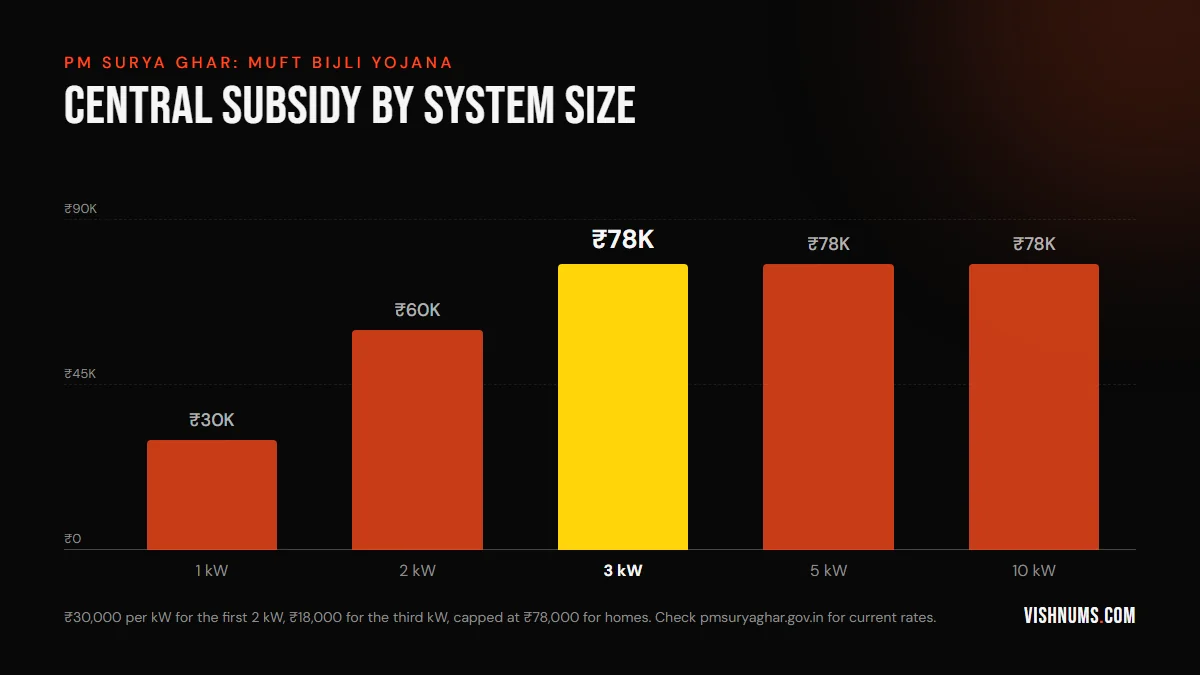
Under PM Surya Ghar, residential consumers can get a central subsidy of ₹30,000 per kW for the first 2 kW and ₹18,000 for the third kW. That makes ₹30,000 for a 1 kW system, ₹60,000 for 2 kW and a maximum of ₹78,000 for 3 kW or more. A larger system does not get a larger subsidy.
At the time of writing, reports say Kerala does not add a separate state top-up for residential rooftop solar, and the earlier KSEB-run subsidy schemes have wound down. Don't promise "state subsidy" in an ad unless you have confirmed a current scheme in writing. Rates, eligibility and process change, so check the official PM Surya Ghar portal and KSEB before you put any number in an ad.
What this means for your advertising:
- The ₹78,000 figure is your strongest number, and it applies to the system size most Kerala homes buy anyway. "Up to ₹78,000 subsidy on a 3 kW rooftop system" is accurate and specific.
- Avoid "free solar" language. The scheme's name includes "Muft Bijli", but homeowners still pay for the system and receive the subsidy afterwards. Ads that imply a free system create angry calls and poor reviews.
- Explain how the subsidy arrives. Most homeowners don't know it is credited to their bank account after installation and inspection. Saying this clearly in the ad and on the call removes a big worry.
Why your ads need a different angle from your competitors
Look at the Meta Ad Library for "solar Kerala" and you'll see the same ad repeated across dozens of installers: a stock photo of panels, the subsidy amount, "Book free site visit." When every ad says the same thing, people choose on price or on whoever calls first.
Your advantage has to come from what surrounds the subsidy:
- You handle the paperwork end to end: portal registration, KSEB feasibility, net-metering application, inspection and subsidy claim. Paperwork fear stops more Kerala homeowners than price.
- Local proof: installations in the same district, ideally the same panchayat or municipality, with the owner's name and bill (with permission).
- After-sales service: who comes when the inverter shows an error, how quickly, and what the warranty actually covers.
- Honest sizing: recommending the system the household needs, not the biggest one you can sell.
Pick one or two of these and make them the centre of your creatives. You can see more on how proof beats generic claims in our Meta ads audit checklist, which applies the same thinking to any account.
Who to target (and who to avoid)
The buyer is a homeowner with a high electricity bill, a suitable roof and the authority to decide. That person is not well described by Meta's interest categories. "Solar energy" and "renewable energy" interests catch students, engineers, environmental enthusiasts and other installers.
What works better:
- Broad targeting with location limits. Choose only the districts your survey and installation teams can reach in a day. If you're based in Thrissur, advertising across all of Kerala means leads in Kasaragod you can't serve profitably.
- Age 30 and above as a sensible starting point, since homeowners making this decision skew older. Test removing the limit once you have data.
- A creative that qualifies. The ad itself does the targeting: "Paying more than ₹3,000 to KSEB every two months?" Only people with that problem stop.
- NRI homeowners. Many Kerala houses belong to families working in the Gulf, who pay the bills and approve upgrades. A separate campaign aimed at the six Gulf states, with copy about remote coordination, can reach the real decision-maker. The setup is explained in how to target NRIs in the Gulf with Meta ads.
Avoid very narrow targeting such as single pin codes with tiny budgets. Meta needs room to find people, and a small audience gets expensive quickly. If your ad sets keep showing "Learning limited", see Meta ads learning limited on a small budget.
Choose the right lead format
You have three practical options.
Instant forms (lead form ads)
The fastest and cheapest per lead, and the most likely to bring in casual leads. Switch the form to Higher intent, so people confirm their details on a final screen, and add qualifying questions. Without these, expect many people who tapped by accident.
Click-to-WhatsApp ads
People like to send a photo of their electricity bill and their roof, which makes WhatsApp a natural fit for solar. You get richer information, but you need someone replying quickly, including evenings and weekends. Read Click-to-WhatsApp vs lead form ads for the trade-offs.
Landing page with a savings calculator
A simple page where people enter their bill and see a suggested system size and estimated subsidy. Fewer leads, but they're more serious, and you can use the page in retargeting. Only show estimates you can stand behind, with a clear note that the site survey decides the final figures.
Most installers do well starting with a higher-intent instant form plus a WhatsApp option, then testing a calculator page once lead volume is steady.
Qualify inside the form
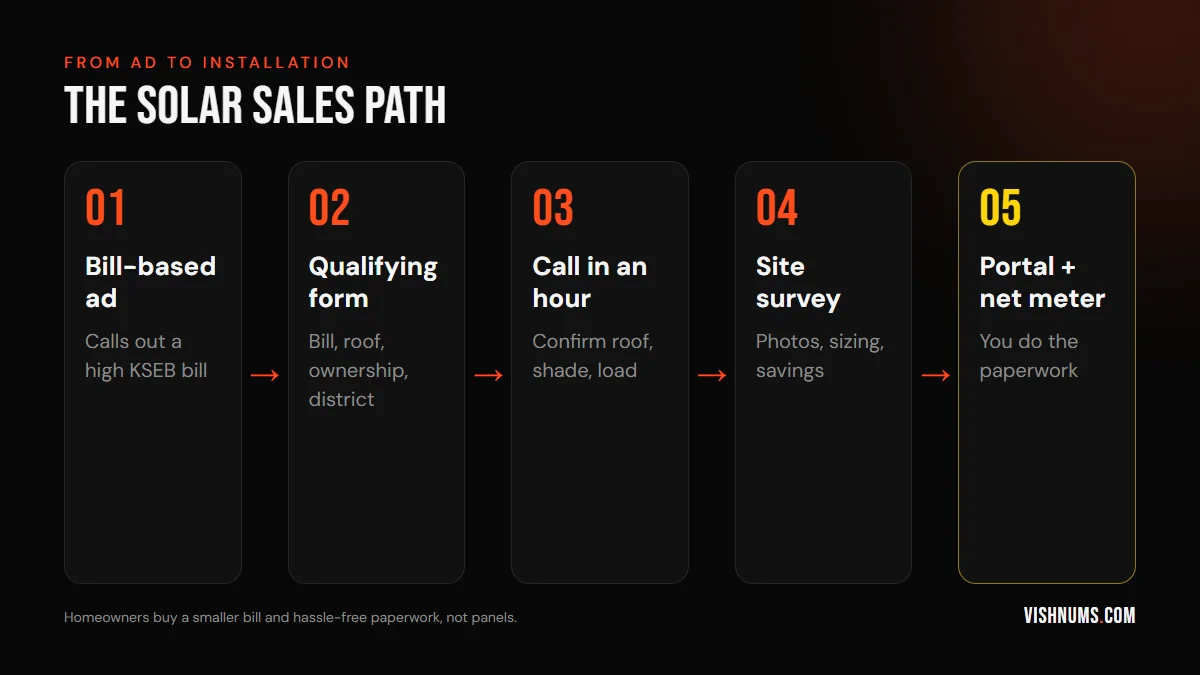
Every question you add reduces lead volume, and that's the point. Here is a form you can adapt:
- 01What is your average KSEB bill every two months? Below ₹1,500 / ₹1,500–3,000 / ₹3,000–6,000 / Above ₹6,000.
- 02Do you own the house? Yes / No, I rent / Building a new house.
- 03What type of roof do you have? Concrete flat roof / Sloped tiled roof / Sheet roof / Not sure.
- 04Which district is the house in? A list of only the districts you serve.
- 05When would you like to install? Within a month / 1–3 months / Just exploring.
Then use the answers. Renters and very low bills get a polite WhatsApp message explaining that solar may not pay back for them yet. "Building a new house" leads go into a separate list, because they'll install months later. "Just exploring" leads get a slower nurture sequence. Your sales team calls the rest first.
On the form's intro screen, set expectations: "Our engineer will call you within one working hour to understand your roof and bill." People who aren't ready to talk tend to drop off there, which saves your team time.
If you already get plenty of leads but few installations, this form change usually helps more than any targeting tweak. Our guide to Facebook ads bringing leads but no sales goes deeper into diagnosing the gap.
Solar ad copy you can adapt
Here are angles that work for Kerala rooftop solar, written so they stay accurate. Replace the bracketed parts with your own details.
The bill angle
Primary text: "Paying ₹4,000 or more to KSEB every two months? A 3 kW rooftop system can cut most of that, and the central government gives up to ₹78,000 subsidy under PM Surya Ghar. We handle the portal registration, KSEB approvals and net meter for you. Free site survey in [district]."
Headline: "Cut your KSEB bill with rooftop solar"
The paperwork angle
Primary text: "Want solar but worried about the paperwork? Portal registration, feasibility, net metering, inspection, subsidy claim: our team does all of it. You just approve the design. [Number] homes installed in [district]."
Headline: "Rooftop solar, paperwork included"
The proof angle
Primary text: "[Customer name] in [town] used to pay ₹[amount] every two months. After installing a 3 kW system with us, the last bill was ₹[amount]. See the installation and hear from them."
Headline: "Real bills from real homes in [district]"
Use real numbers from real customers, with permission, and keep a copy of their bills on file. Write the Malayalam versions properly rather than translating word for word; see regional-language ads in Malayalam, Tamil and Kannada for how to approach that.
Creatives that work for solar
The best-performing formats for installers are usually simple and real:
- Bill comparison image: last year's bill next to this year's, same household, numbers highlighted. Blur personal details.
- Installation time-lapse: 20 to 30 seconds of your crew installing on a typical Kerala concrete roof, ending with the inverter switched on.
- Paperwork explainer Reel: your engineer walking through the five steps from registration to subsidy credit, in Malayalam, with simple on-screen text.
- Customer testimonial: the homeowner, standing in front of their house, saying what they paid before and after.
- Monsoon explainer: a common question in Kerala is whether solar works during the rains. A short, honest explanation that output drops in heavy cloud but the system still pays back over the year answers a real objection.
Avoid claims like "zero electricity bill forever". Fixed charges remain, usage changes, and a disappointed customer's one-star review costs more than the sale was worth.
The first call: what to say
Speed matters more than script, but a structure helps. Call within an hour; leads that wait until the next day are often already talking to two other installers.
A simple call flow:
- 01Confirm the basics: "I see your bill is around ₹4,000 every two months, and it's a concrete roof in Thrissur. Is that right?"
- 02Ask about usage: air conditioners, water heater, home office, electric vehicle plans. This tells you what size makes sense.
- 03Ask about shade: coconut trees and taller neighbouring buildings are common in Kerala and affect output.
- 04Explain the process in one minute: survey, design and quote, registration, installation, net meter, inspection, subsidy credit.
- 05Book the survey: offer two specific slots. "Thursday morning or Saturday afternoon?"
- 06Send a WhatsApp summary right after the call with the survey time and your engineer's name.
If the decision involves family abroad, offer a short video call with them, or send a summary they can review. Many solar decisions in Kerala happen over a family WhatsApp group.
Measure the whole pipeline
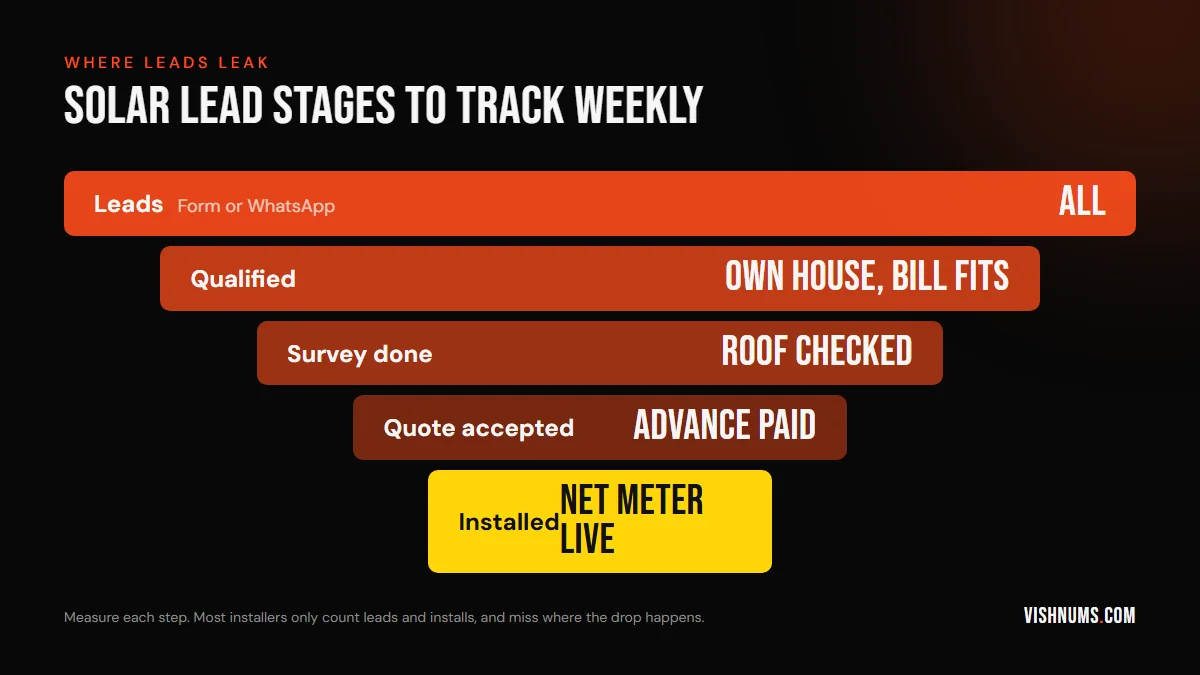
Most installers track two numbers: leads and installations. That hides where the problem is. Track five stages every week, by campaign and by ad:
- Leads received
- Qualified (owns the house, bill and roof fit)
- Site surveys completed
- Quotes accepted with an advance
- Installations completed and net meter live
If qualified leads are low, the problem is targeting or the creative. If surveys are low, the problem is follow-up speed. If quotes are accepted but installations stall, the problem is operations or paperwork. A simple Google Sheet is enough; see how to get Facebook lead ads into Google Sheets for free.
Once you have a few weeks of data, send the later stages back to Meta as conversions. When Meta knows which leads became surveys and installations, it can optimise for people who look like your buyers instead of people who like filling forms. The method is explained in sending CRM results to Meta's Conversions API.
A worked budget example
Here's an example of how to think about budget, using made-up round numbers rather than benchmarks; your own costs will differ by district, season and offer.
Say an installer spends ₹30,000 a month on Meta ads and gets 150 leads (₹200 per lead). With a qualifying form, 60% are qualified, giving 90. Of those, half agree to a site survey: 45 surveys. If one in four surveys becomes an installation, that's about 11 installations from ₹30,000, or roughly ₹2,700 of ad spend per installation.
Now compare the margin on one installation with ₹2,700. For most installers, that is very healthy, which is why the real constraint is usually survey capacity and follow-up, not ad budget. Before raising spend, make sure your team can survey and install more homes without slipping on speed or quality.
Use this kind of calculation to set your limits: decide the most you're willing to spend for one installation, then work back to what a lead can cost at your conversion rates.
Seasonality in Kerala
Solar interest isn't flat through the year:
- Summer (March to May) brings the highest bills as air conditioners and fans run constantly. This is usually the strongest season for enquiries.
- The monsoon brings fewer enquiries and harder installation days, but serious buyers still plan. Use it to nurture leads and collect testimonials.
- Before Onam and the year end, some families plan home upgrades along with festival spending.
- When KSEB tariffs change, news coverage creates a short spike of interest. Have an ad ready that explains what the change means for a typical household.
Shift budget towards the high season rather than keeping it flat all year, and keep a small always-on campaign so you don't restart the learning phase from zero.
Where solar campaigns go wrong
- Advertising across all of Kerala when the team can only serve two or three districts.
- Using interest targeting for "solar" and filling the funnel with non-buyers.
- Easy forms with no questions, which bring in large numbers of junk leads.
- Slow follow-up. A lead called the next day has often already booked a survey with someone else.
- Overpromising savings or implying the system is free.
- Ignoring the decision-maker abroad in NRI households.
- Only measuring cost per lead. A cheap lead that never installs is the most expensive lead you have.
- No after-sales content. Service is a buying reason; show it.
Your first 90 days
First month: set up a higher-intent form with qualifying questions, launch two or three creatives (bill angle, paperwork angle, installation video), limit locations to your service districts, and call every lead within an hour. Track all five pipeline stages in a sheet.
Second month: pause the weakest creative, add a customer testimonial, test a Click-to-WhatsApp ad, and start a separate NRI campaign if your district has many Gulf households. Review which form answers predict installations.
Third month: send survey and installation stages back to Meta as conversions, increase budget on the campaigns with the lowest cost per installation (not per lead), and build a referral offer for installed customers. Referrals from happy neighbours are often your cheapest installations.
Sources and further reading
Subsidy rates and KSEB procedures are revised from time to time. Confirm the latest figures here:
- PM Surya Ghar: Muft Bijli Yojana national portal for subsidy rates, vendor registration and applications
- Kerala State Electricity Board for net-metering and feasibility procedures
Frequently asked questions
What is the solar subsidy in Kerala under PM Surya Ghar?
The central subsidy is ₹30,000 per kW for the first 2 kW and ₹18,000 for the third kW, capped at ₹78,000 for residential systems. Reports say Kerala adds no separate state top-up at the time of writing. Check the official portal for current rates before advertising them.
How do solar installers get good leads in Kerala?
Run Meta ads that qualify by electricity bill, house ownership and roof type; limit locations to districts you can serve; call within an hour; and build trust with real local installations and testimonials. A strong Google Business Profile and referral offers add more.
Should solar ads target people interested in solar energy?
Usually not. Interest targeting finds curious people rather than buyers. Broad targeting within your service area, with a creative that calls out high KSEB bills, tends to find homeowners who are ready to act.
Are lead forms or WhatsApp better for solar ads?
Both work. Higher-intent instant forms with qualifying questions give you structured leads; WhatsApp lets people share bills and roof photos. Many installers run both and compare cost per installation.
How much should a solar installer spend on Meta ads?
Work backwards from what you can afford per installation and your survey capacity. Start with a budget your team can follow up properly, measure cost per installation for a month, then scale the campaigns that produce installations.
Can I advertise "free solar" under PM Surya Ghar?
Avoid it. The homeowner still pays for the system and receives the subsidy afterwards. "Free" claims mislead people and lead to complaints and poor reviews.
Installing rooftop solar and want leads that turn into installations? Request a quote.
Ads, a website that converts, or both: get a custom quote.